App Settings
General
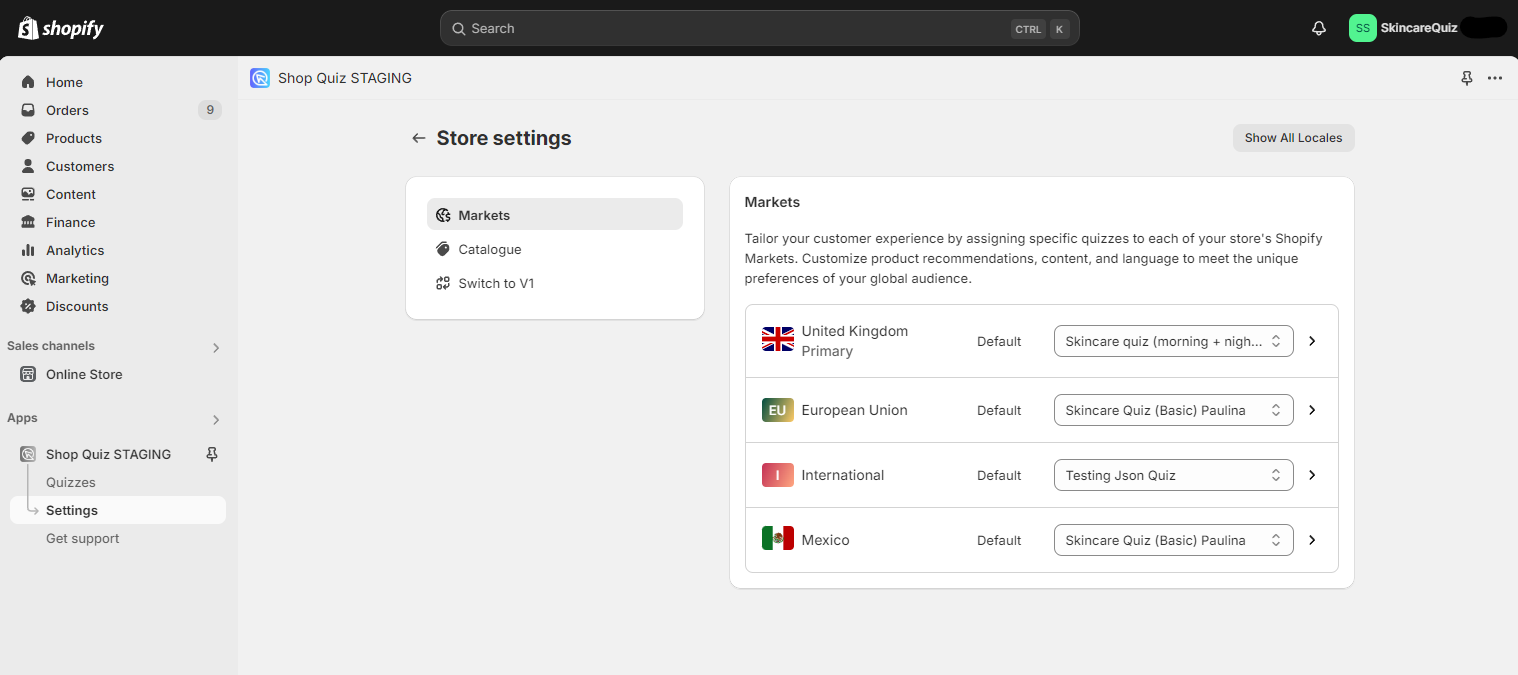
The App settings menu holds these tabs:
General - Add a contact email for support to get notified about quiz issues, improvements or important updates (support only, no marketing emails).
Tip
You can add multiple contact emails by separating them with a comma.
Shopify Markets - Assign quizzes to different markets and languages via the Shopify Markets tab.
Shopify Customers - Enable automatic syncing of quiz leads to your Shopify Customers list via the Shopify Customers tab.
Catalog - Import tags, vendors, variants and metafields from the Catalog tab, or check the import status.
SMTP settings - Provide your email SMTP settings to send result emails from your email provider.
Plans and pricing - Manage your current subscription and plan details from the Plans and pricing tab.
Newsletter - Subscribe to the Newsletter to get notified about new features, updates and important announcements.
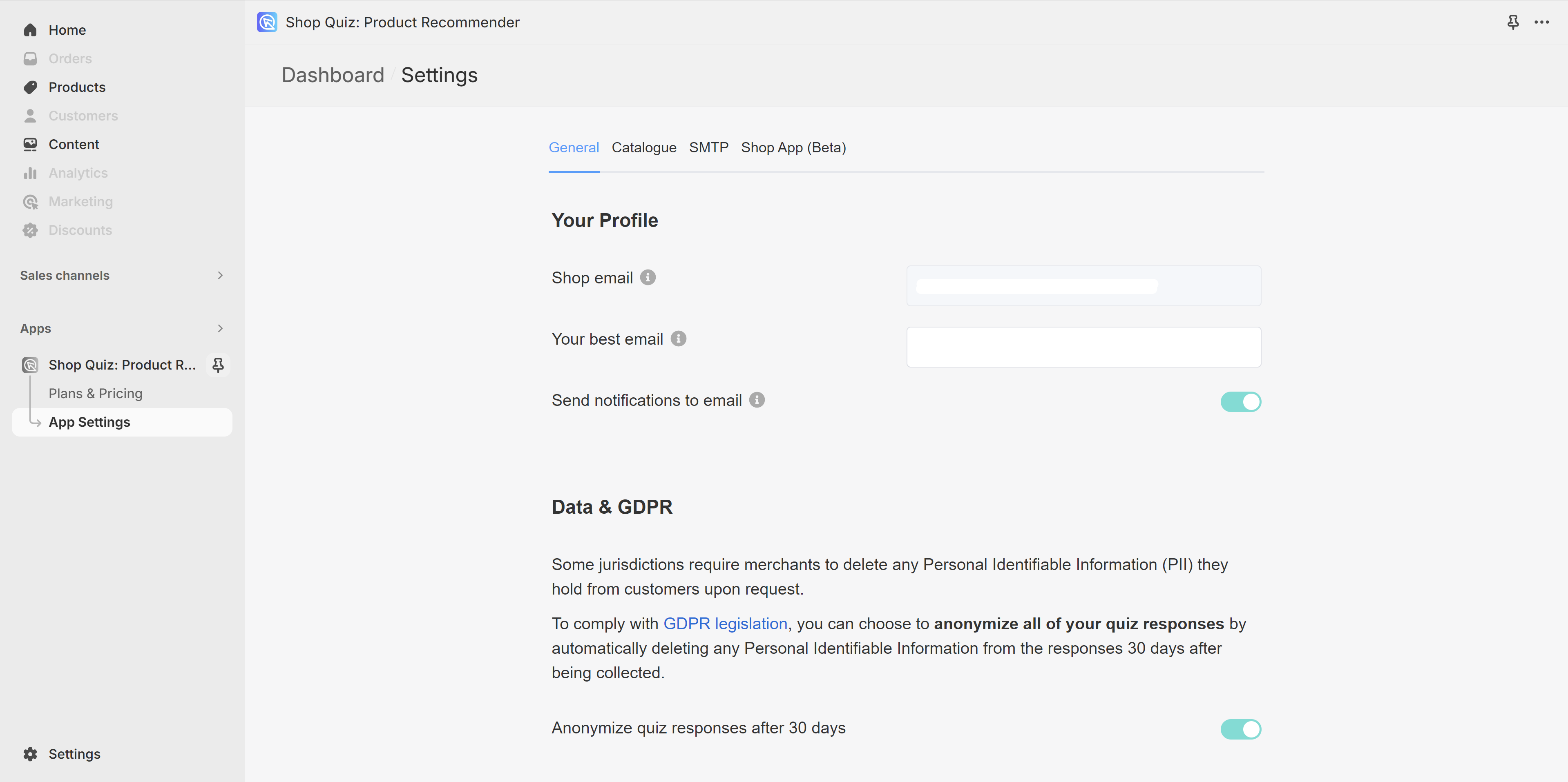
Your Profile
Shop email - Your main store contact email. RevenueHunt updates it each time your store is synced. Change it in your store settings, not in the app.
Your best email - Provide your best email (not your store email) for communication in case of issues.
Send notifications to email - Toggle the button to activate the notification emails to your best email. Once active, the notifications that appear on the dashboard are also sent to your best email. For example, in case you go over your plan's limits, CSV export completions or connection issues.
Data & GDPR
Anonymize quiz responses after 30 days - Some jurisdictions require merchants to remove Personal Identifiable Information (PII) from stored customer data upon request. To comply with GDPR legislation, you can choose to anonymize quiz responses by automatically deleting PII from responses 30 days after collection. This keeps non-personal response records for analytics and usage tracking. It does not purge responses or reset usage. To activate this setting toggle the icon.
Your Profile
Shop email - Your main store contact email. RevenueHunt updates it each time your store is synced. Change it in your store settings, not in the app.
Your best email - Provide your best email (not your store email) for communication in case of issues.
Send notifications to email - Toggle the button to activate the notification emails to your best email. Once active, the notifications that appear on the dashboard are also sent to your best email. For example, in case you go over your plan's limits, CSV export completions or connection issues.
Data & GDPR
Anonymize quiz responses after 30 days - Some jurisdictions require merchants to remove Personal Identifiable Information (PII) from stored customer data upon request. To comply with GDPR legislation, you can choose to anonymize quiz responses by automatically deleting PII from responses 30 days after collection. This keeps non-personal response records for analytics and usage tracking. It does not purge responses or reset usage. To activate this setting toggle the icon.
Your Profile
Shop email - Your main store contact email. RevenueHunt updates it each time your store is synced. Change it in your store settings, not in the app.
Your best email - Provide your best email (not your store email) for communication in case of issues.
Send notifications to email - Toggle the button to activate the notification emails to your best email. Once active, the notifications that appear on the dashboard are also sent to your best email. For example, in case you go over your plan's limits, CSV export completions or connection issues.
Data & GDPR
Anonymize quiz responses after 30 days - Some jurisdictions require merchants to remove Personal Identifiable Information (PII) from stored customer data upon request. To comply with GDPR legislation, you can choose to anonymize quiz responses by automatically deleting PII from responses 30 days after collection. This keeps non-personal response records for analytics and usage tracking. It does not purge responses or reset usage. To activate this setting toggle the icon.
Your Profile
Shop email - Your main store contact email. RevenueHunt updates it each time your store is synced. Change it in your store settings, not in the app.
Your best email - Provide your best email (not your store email) for communication in case of issues.
Send notifications to email - Toggle the button to activate the notification emails to your best email. Once active, the notifications that appear on the dashboard are also sent to your best email. For example, in case you go over your plan's limits, CSV export completions or connection issues.
Data & GDPR
Anonymize quiz responses after 30 days - Some jurisdictions require merchants to remove Personal Identifiable Information (PII) from stored customer data upon request. To comply with GDPR legislation, you can choose to anonymize quiz responses by automatically deleting PII from responses 30 days after collection. This keeps non-personal response records for analytics and usage tracking. It does not purge responses or reset usage. To activate this setting toggle the icon.
Your Profile
Shop email - Your main store contact email. RevenueHunt updates it each time your store is synced. Change it in your store settings, not in the app.
Your best email - Provide your best email (not your store email) for communication in case of issues.
Send notifications to email - Toggle the button to activate the notification emails to your best email. Once active, the notifications that appear on the dashboard are also sent to your best email. For example, in case you go over your plan's limits, CSV export completions or connection issues.
Data & GDPR
Anonymize quiz responses after 30 days - Some jurisdictions require merchants to remove Personal Identifiable Information (PII) from stored customer data upon request. To comply with GDPR legislation, you can choose to anonymize quiz responses by automatically deleting PII from responses 30 days after collection. This keeps non-personal response records for analytics and usage tracking. It does not purge responses or reset usage. To activate this setting toggle the icon.
Shopify Markets
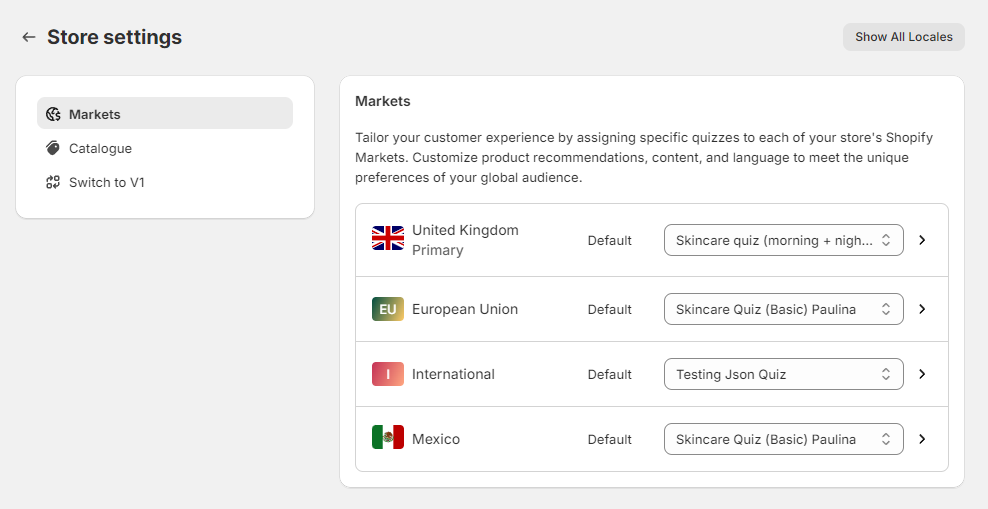
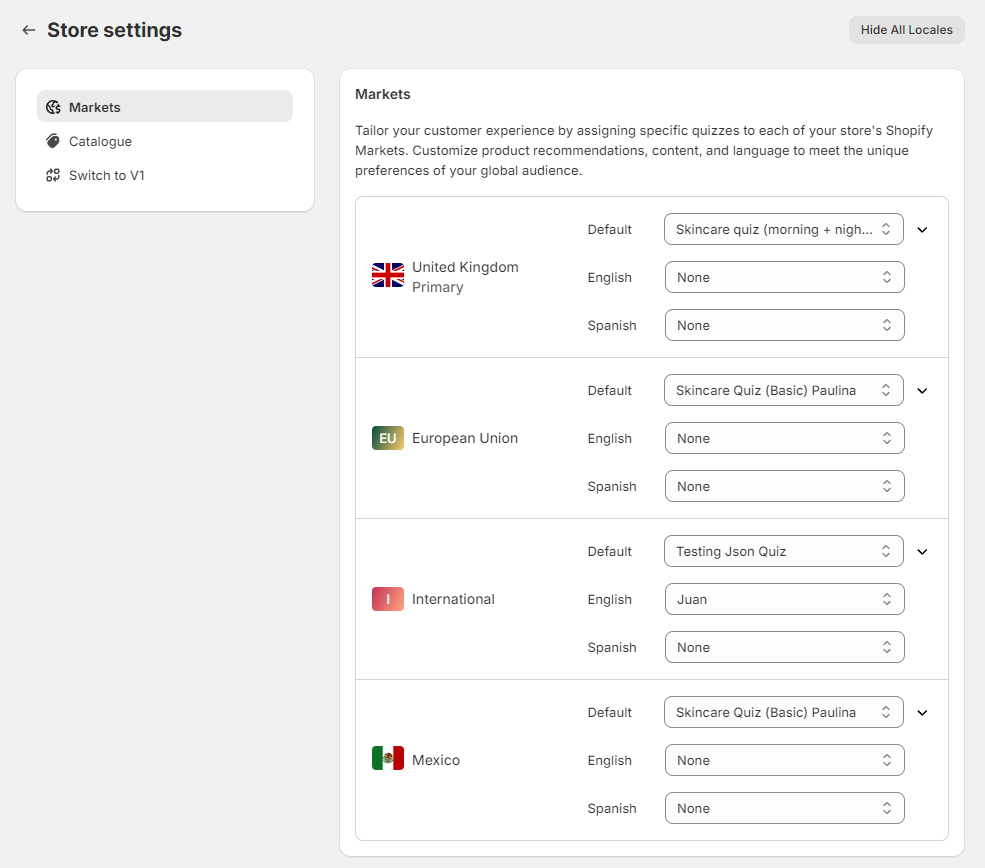
Tailor your customer experience by assigning specific quizzes to each of your store's Shopify Markets. Customize product recommendations, content, and language to meet the unique preferences of your global audience.
Click the dropdown list to select a quiz that will be shown by default to customers on that Markets version of your store.
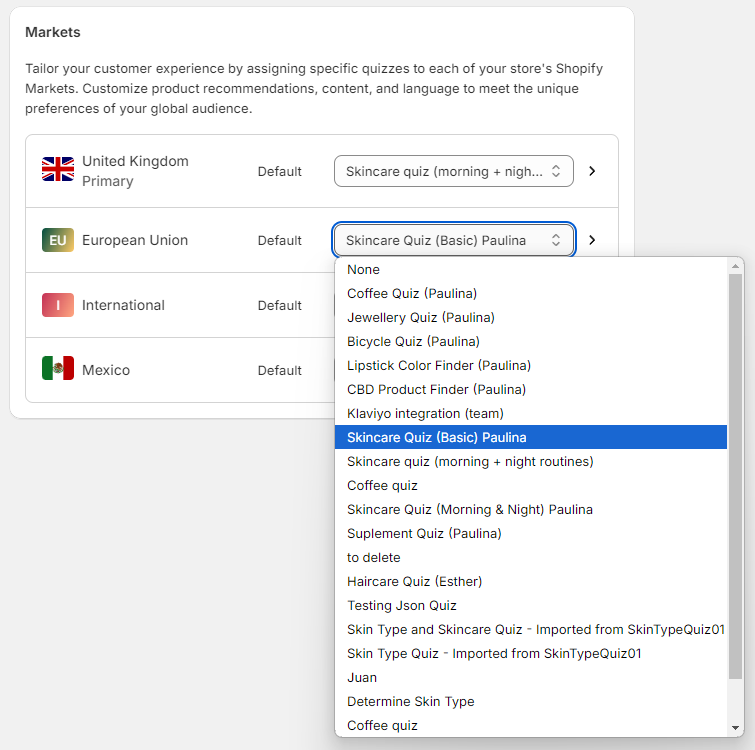
> - Click to expand a market and show its languages and its currency format. You can then pick a different default quiz for each language in that market.
v - Click to collapse the market again, back to the view without languages.
Default - Select the default quiz for a specific region.
Language - Select a default quiz for a specific language in this region.
Currency - Type {{amount}} EUR or ${{amount}} to change the currency format as displayed on the results page.
Shopify Markets is a Built for Shopify feature
Shopify Markets is not available in the legacy version of the app.
Shopify Markets is a Built for Shopify feature
Shopify Markets is not available on this platform.
Shopify Markets is a Built for Shopify feature
Shopify Markets is not available on this platform.
Shopify Markets is a Built for Shopify feature
Shopify Markets is not available on this platform.
Shopify Markets is a Built for Shopify feature
Shopify Markets is not available on this platform.
Shopify Customers
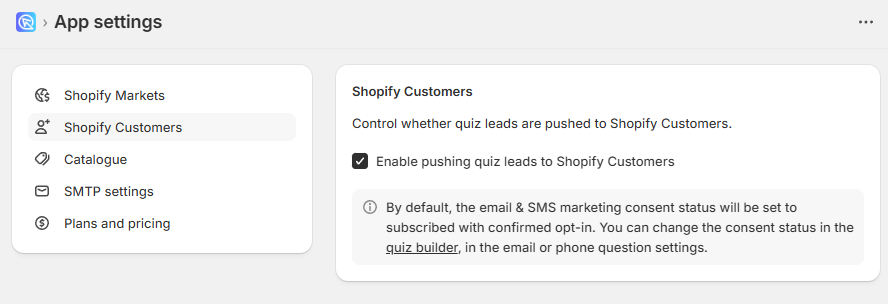
Enable automatic syncing of quiz leads to your Shopify Customers list. When enabled, every quiz completion that captures an email will create or update a customer profile in Shopify.
Enable pushing quiz leads to Shopify Customers - Tick to sync quiz leads to Shopify Customers. This is a global setting that applies to all quizzes.
Consent defaults to subscribed
New contacts are created with the email and SMS marketing consent status set to subscribed, with confirmed opt-in. To change it, open the email or phone question settings in the Quiz builder.
What data is sent:
- Email address (required)
- First name and last name (if collected in quiz)
- Phone number (if collected in quiz)
- Customer tags (from tagged quiz choices)
Note
If a customer with the same email already exists in Shopify, their profile will be updated with the new customer tags from the quiz.
Tip
Check how to send quiz leads to Shopify Customers for detailed instructions on setting up Shopify Flows with customer tags.
Shopify Flow
The Shopify Flow card sits directly below the Shopify Customers card. It lets you automate actions after an identified customer completes a quiz, using the Quiz Completed trigger from Product Recommendation Quiz.
The label next to the heading shows the current status:
Flow active- a workflow using the trigger is turned on.Flow inactive- a workflow was detected but is not turned on.Flow not detected- Shopify has not reported a workflow using this trigger yet.
Open Shopify Flow - Opens Shopify Flow so you can create or edit the workflow.
Note
The trigger only fires for identified customers. Your quiz needs an email question, and Enable pushing quiz leads to Shopify Customers must be enabled above.
Tip
Check Automate Quiz Completions with Shopify Flow for the full setup and the list of data the trigger provides.
Set this per quiz in the legacy app
The Shopify Customers integration is set for each quiz separately, in the Connect tab of the Quiz Builder.
Shopify Customers is a Built for Shopify feature
Shopify Customers is not available on this platform.
Shopify Customers is a Built for Shopify feature
Shopify Customers is not available on this platform.
Shopify Customers is a Built for Shopify feature
Shopify Customers is not available on this platform.
Shopify Customers is a Built for Shopify feature
Shopify Customers is not available on this platform.
Catalog
Product names, descriptions, prices and images shown in your quiz results are pulled live from Shopify, so they are always up to date.
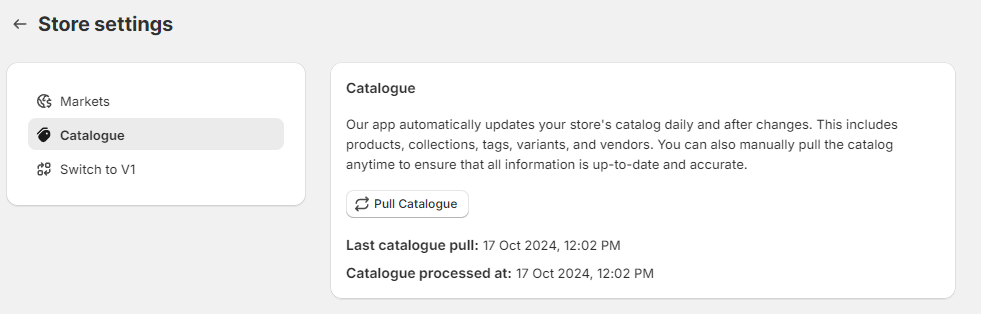
The catalog import updates the lists of tags, collections, vendors, variants and metafields available in the quiz builder. This happens automatically every 24 hours. If you have added new tags or collections in Shopify and do not see them in the builder, run a manual import.
Import tags, vendors, variants & metafields - Shows the current import status and how many items were imported. It also holds the Import now button. Open Import history to see past imports, with the tag, vendor, variant and metafield counts for each.
Import now - Start a new catalog import. This typically takes a few minutes depending on your catalog size.
Refresh - Refresh the import status and tag/vendors/variants/metafields quantities.
Low inventory filter - Controls which products are eligible to be recommended in the quiz results, based on stock levels.
When unchecked (default behavior): Out-of-stock products will still appear in recommendations, but the "Add to cart" button will automatically display "Sold out" and become disabled. Customers cannot add out-of-stock variants to their cart. The "Sold out" text can be customized in Quiz settings > Quiz content under Buttons.
When checked: If you check the Filter products by inventory level box, the app will hide any products that are low or out of stock from quiz recommendations entirely. This prevents customers from seeing products that are unavailable to purchase. Once checked, the Minimum stock level field becomes available. Set the stock level a product has to reach to stay eligible for recommendations. The value can be negative.
How products with multiple variants are handled
A product is only hidden from recommendations when all of its variants are below the minimum stock threshold. If a product has at least one variant above the threshold, the product remains eligible for recommendations.
Draft products - Controls whether products in draft status are eligible to be recommended in the quiz results.
Include draft products in recommendations - When enabled, recommendations will include products or variants that are in draft status. Draft products can be recommended, and they appear in the Quiz preview and under Responses > Analysis. Use this to build and test a quiz with draft products before you publish them. Draft products are not shown in the live quiz until they are published.
Collection product order - Control how products are ordered within collections for recommendations.
Catalog mode - Choose between Default (faster imports) and Preserve collection order.
Default (faster imports) - When products have equal upvotes, they appear in random order. This mode imports your catalog faster.
Preserve collection order - When products have equal upvotes, they appear in the same order as arranged in your Shopify collections. Products placed earlier in your collection appear first in recommendations.
After changing this setting
You must click Import now to apply the change. The new ordering takes effect only after a fresh import.
When to use Preserve collection order?
Enable this if you have arranged products by hand in your Shopify collections. For example, best-sellers first, or new arrivals at the top. The same order is then used in quiz recommendations.
With Preserve collection order enabled, products are imported in the order they appear in your Shopify collections. When two products have equal upvotes, the one placed earlier in the collection appears first. This works with manual sorting and with Shopify's automatic collection sorting.
For example: Imagine you have a "Best Sellers" collection with products arranged by sales:
- Product A (best seller)
- Product B (second best)
- Product C (third best)
If Products A and C both receive 3 upvotes in a quiz:
- With Default mode: Either could appear first (random)
- With Preserve collection order: Product A appears first (position 1 beats position 3)
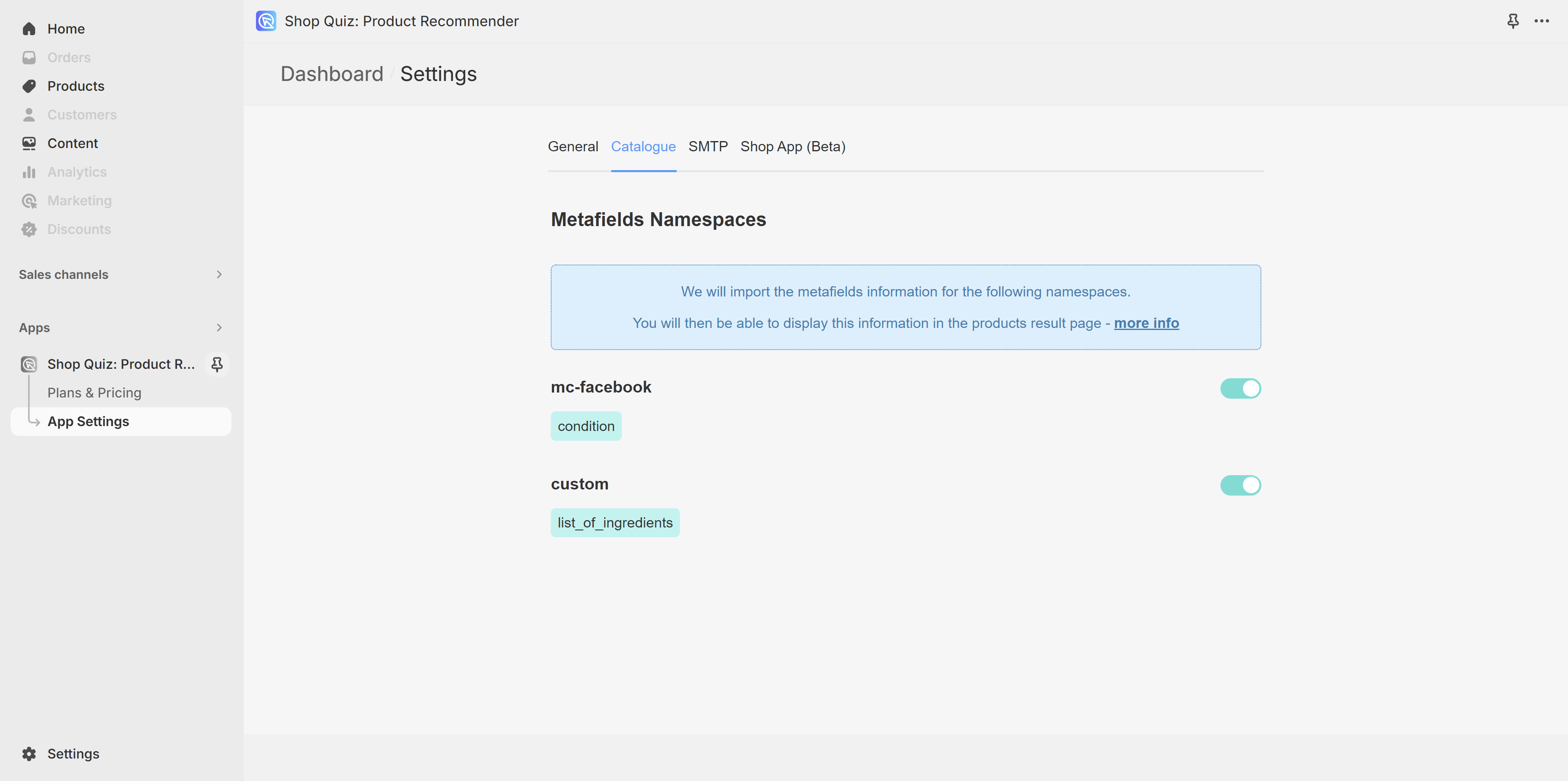
Metafields Namespaces - RevenueHunt imports the metafield information for these namespaces. You can then show that information on the results page. This section lists the metafield categories found in your store. Toggle the button to activate a namespace.
Tip
Follow this article to show metafields in the quiz: How to add product metafields.
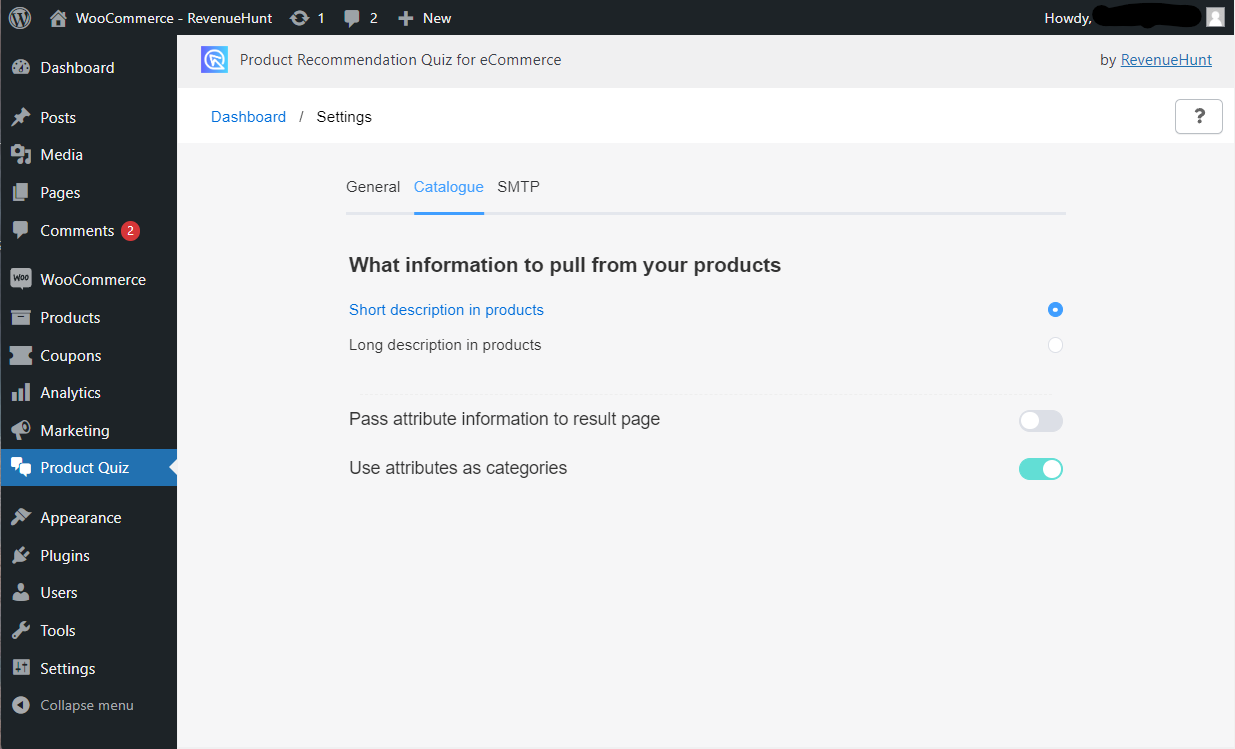
What information to pull from your products - Choose custom settings for your products within the app.
Short/Long description in products - By selecting one or the other you can choose which description of your products will be shown on the results page.
Pass attribute information to result page - Toggle to activate or deactivate. Once this option is active, the app will pass attributes to your results page. You need to run a catalog sync after activating this option. Follow this article to learn how to show these attributes on the results page once they are synced: How to add product metafields.
Use attributes as categories - Lets you use your store's attributes to group products into categories that can be then linked to choices via the Link Collections/Link Categories tab.
Not available on this platform
This version of the app does not have Catalogue settings.
Not available on this platform
This version of the app does not have Catalogue settings.
To access the Catalogue settings in the Standalone version of the RevenueHunt app, open the Success Checklist or go to your in-app Catalogue.
SMTP settings
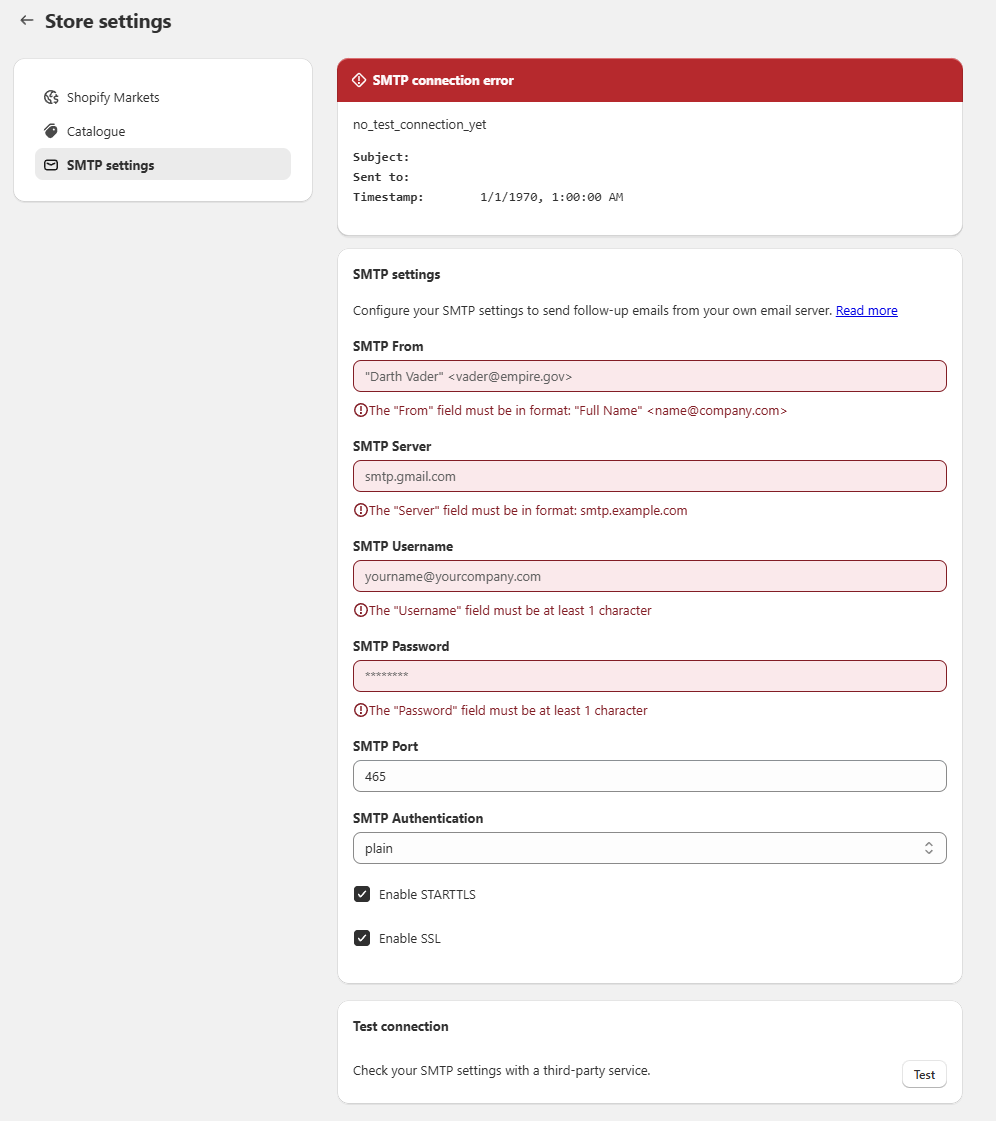
SMTP Settings
SMTP stands for Simple Mail Transfer Protocol. SMTP is a connection protocol that lets third-party apps, such as the RevenueHunt app, send emails through your email server.
When you connect the RevenueHunt app to your SMTP server, the result emails stop being sent from the no-reply@prq.email account. They are sent from your own email account instead.
Tip
Check how to send result emails from your own server for detailed instructions on how to set this up.
SMTP From - Set what name and email the customer will see when they receive the email. The "From" field must be in format: "Full Name" <name@company.com>.
SMTP Server - Set your server URL. The "Server" field must be in format: smtp.example.com.
SMTP Username - Set your SMTP Username.
SMTP Password - Provide the password associated with the username.
SMTP Port - Set the SMTP port (25, 465, 587 or 2525)
SMTP Authentication - Select the method your provider uses from the dropdown. The choices are plain, login and cram-md5, and plain is the default. Most providers use plain.
Encryption - Pick the encryption your provider asks for. The two are exclusive, so selecting one clears the other.
STARTTLS- Opens an insecure connection and upgrades it to an encrypted one. It usually runs on port 587, and it is selected by default.SSL/TLS- Starts the connection encrypted rather than upgrading it afterwards. It usually runs on port 465.
Test connection - Send a test email with the credentials above. The app reports SMTP connection successful, with the subject, the recipient and the timestamp.
Enable sending emails using your own SMTP server - Switches the app over to your server. It stays greyed out until a connection test passes, so run Test connection first.
Troubleshooting
If you see an error check your SMTP settings with the help of a third-party tool such as Gmass or any other SMTP test site. If your settings work there, they should work in the app too. If you still have problems, contact your developer or your SMTP provider.
SMTP Settings
SMTP stands for Simple Mail Transfer Protocol. SMTP is a connection protocol that lets third-party apps, such as the RevenueHunt app, send emails through your email server.
When you connect the RevenueHunt app to your SMTP server, the result emails stop being sent from the no-reply@prq.email account. They are sent from your own email account instead.
Tip
Check how to send result emails from your own server for detailed instructions on how to set this up.
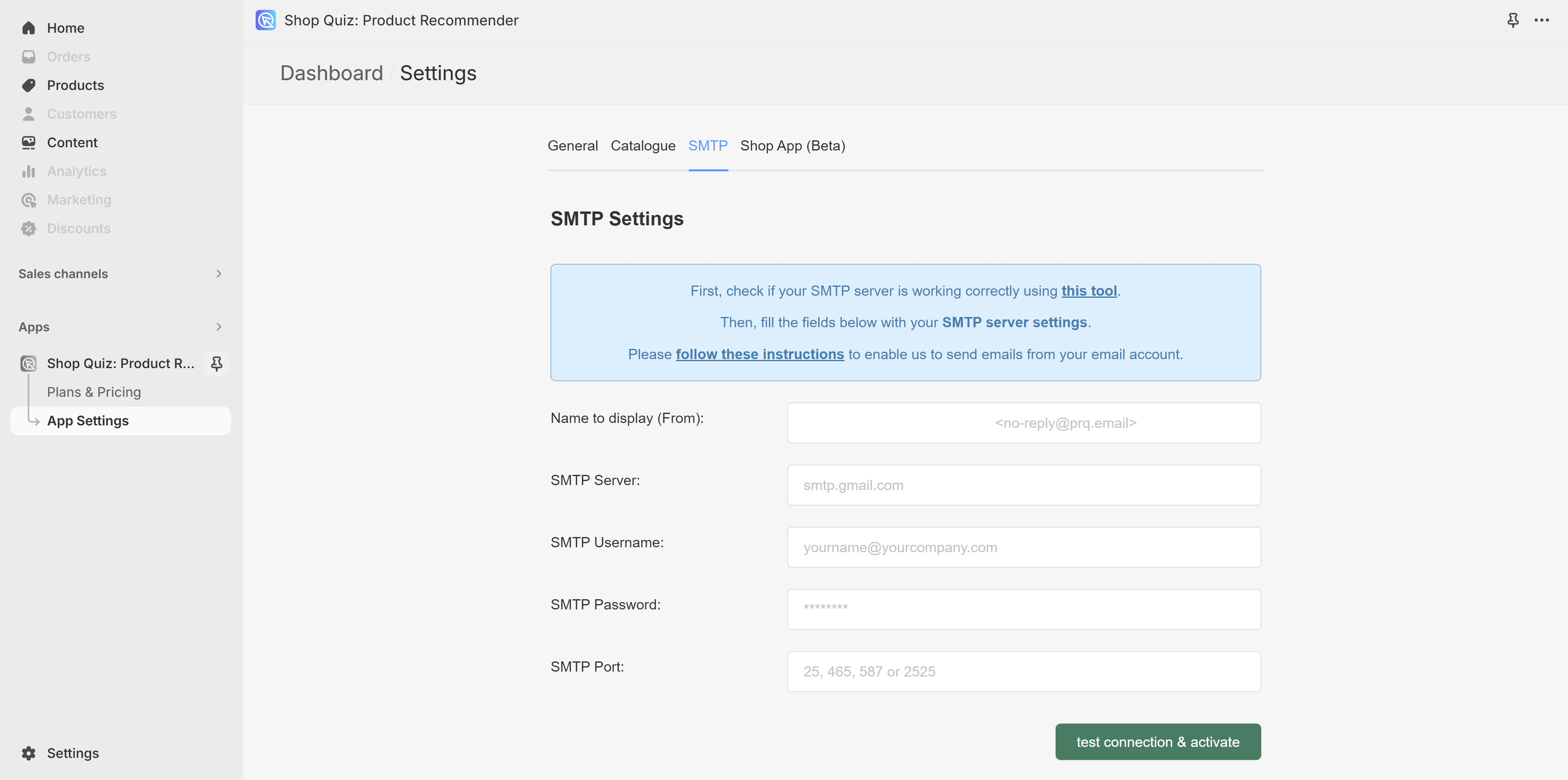
Name to display(From): - Set what name and email the customer will see when they receive the email.
SMTP Server - Set your server URL.
SMTP Username - Set your SMTP Username.
SMTP Password - Provide the password associated with the username.
SMTP Port - Set the SMTP port (25, 465, 587 or 2525)
test connection & activate - Once you have entered your credentials, test whether the connection to your SMTP server works. If you see an error check your SMTP settings with the help of a third-party tool such as Gmass or any other SMTP test site. If your settings work there, they should work in the app too. If you still have problems, contact your developer or your SMTP provider.
SMTP Settings
SMTP stands for Simple Mail Transfer Protocol. SMTP is a connection protocol that lets third-party apps, such as the RevenueHunt app, send emails through your email server.
When you connect the RevenueHunt app to your SMTP server, the result emails stop being sent from the no-reply@prq.email account. They are sent from your own email account instead.
Tip
Check how to send result emails from your own server for detailed instructions on how to set this up.
Name to display(From): - Set what name and email the customer will see when they receive the email.
SMTP Server - Set your server URL.
SMTP Username - Set your SMTP Username.
SMTP Password - Provide the password associated with the username.
SMTP Port - Set the SMTP port (25, 465, 587 or 2525)
test connection & activate - Once you have entered your credentials, test whether the connection to your SMTP server works. If you see an error check your SMTP settings with the help of a third-party tool such as Gmass or any other SMTP test site. If your settings work there, they should work in the app too. If you still have problems, contact your developer or your SMTP provider.
SMTP Settings
SMTP stands for Simple Mail Transfer Protocol. SMTP is a connection protocol that lets third-party apps, such as the RevenueHunt app, send emails through your email server.
When you connect the RevenueHunt app to your SMTP server, the result emails stop being sent from the no-reply@prq.email account. They are sent from your own email account instead.
Tip
Check how to send result emails from your own server for detailed instructions on how to set this up.
Name to display(From): - Set what name and email the customer will see when they receive the email.
SMTP Server - Set your server URL.
SMTP Username - Set your SMTP Username.
SMTP Password - Provide the password associated with the username.
SMTP Port - Set the SMTP port (25, 465, 587 or 2525)
test connection & activate - Once you have entered your credentials, test whether the connection to your SMTP server works. If you see an error check your SMTP settings with the help of a third-party tool such as Gmass or any other SMTP test site. If your settings work there, they should work in the app too. If you still have problems, contact your developer or your SMTP provider.
SMTP Settings
SMTP stands for Simple Mail Transfer Protocol. SMTP is a connection protocol that lets third-party apps, such as the RevenueHunt app, send emails through your email server.
When you connect the RevenueHunt app to your SMTP server, the result emails stop being sent from the no-reply@prq.email account. They are sent from your own email account instead.
Tip
Check how to send result emails from your own server for detailed instructions on how to set this up.
Name to display(From): - Set what name and email the customer will see when they receive the email.
SMTP Server - Set your server URL.
SMTP Username - Set your SMTP Username.
SMTP Password - Provide the password associated with the username.
SMTP Port - Set the SMTP port (25, 465, 587 or 2525)
test connection & activate - Once you have entered your credentials, test whether the connection to your SMTP server works. If you see an error check your SMTP settings with the help of a third-party tool such as Gmass or any other SMTP test site. If your settings work there, they should work in the app too. If you still have problems, contact your developer or your SMTP provider.
SMTP Settings
SMTP stands for Simple Mail Transfer Protocol. SMTP is a connection protocol that lets third-party apps, such as the RevenueHunt app, send emails through your email server.
When you connect the RevenueHunt app to your SMTP server, the result emails stop being sent from the no-reply@prq.email account. They are sent from your own email account instead.
Tip
Check how to send result emails from your own server for detailed instructions on how to set this up.
Name to display(From): - Set what name and email the customer will see when they receive the email.
SMTP Server - Set your server URL.
SMTP Username - Set your SMTP Username.
SMTP Password - Provide the password associated with the username.
SMTP Port - Set the SMTP port (25, 465, 587 or 2525)
test connection & activate - Once you have entered your credentials, test whether the connection to your SMTP server works. If you see an error check your SMTP settings with the help of a third-party tool such as Gmass or any other SMTP test site. If your settings work there, they should work in the app too. If you still have problems, contact your developer or your SMTP provider.
Plans and pricing
Check Plans & Pricing for more information on the different plans and pricing options available.
Check Plans & Pricing for more information on the different plans and pricing options available.
Check Plans & Pricing for more information on the different plans and pricing options available.
Check Plans & Pricing for more information on the different plans and pricing options available.
Check Plans & Pricing for more information on the different plans and pricing options available.
Check Plans & Pricing for more information on the different plans and pricing options available.
Newsletter
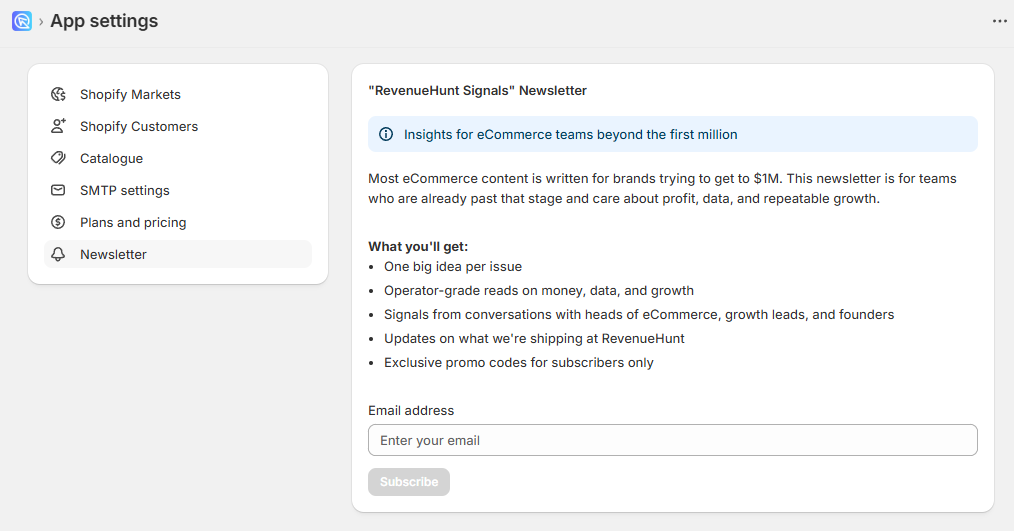
Email address - Enter an email address to subscribe to the newsletter.
The newsletter signup is a Built for Shopify feature
This version of the app has no newsletter signup in App Settings.
The newsletter signup is a Built for Shopify feature
This version of the app has no newsletter signup in App Settings.
The newsletter signup is a Built for Shopify feature
This version of the app has no newsletter signup in App Settings.
The newsletter signup is a Built for Shopify feature
This version of the app has no newsletter signup in App Settings.
The newsletter signup is a Built for Shopify feature
This version of the app has no newsletter signup in App Settings.
← Previous: Plans & Pricing Next: Resources →