How to Ask for Marketing/Data Processing Consent
Asking for marketing consent, or for acceptance of data processing, inside the quiz is an efficient way to comply with GDPR and similar rules.
This article covers three ways to add a consent request to a quiz.
Which option to choose
For the reasoning behind each one, see Smart Ways to Ask for Marketing/Data Processing Consent in Your Product Recommendation Quiz.
Add a link to your privacy policy
Consent starts with a privacy policy the customer can find. Link to it from any text element of the quiz, using the link button in the text editor.
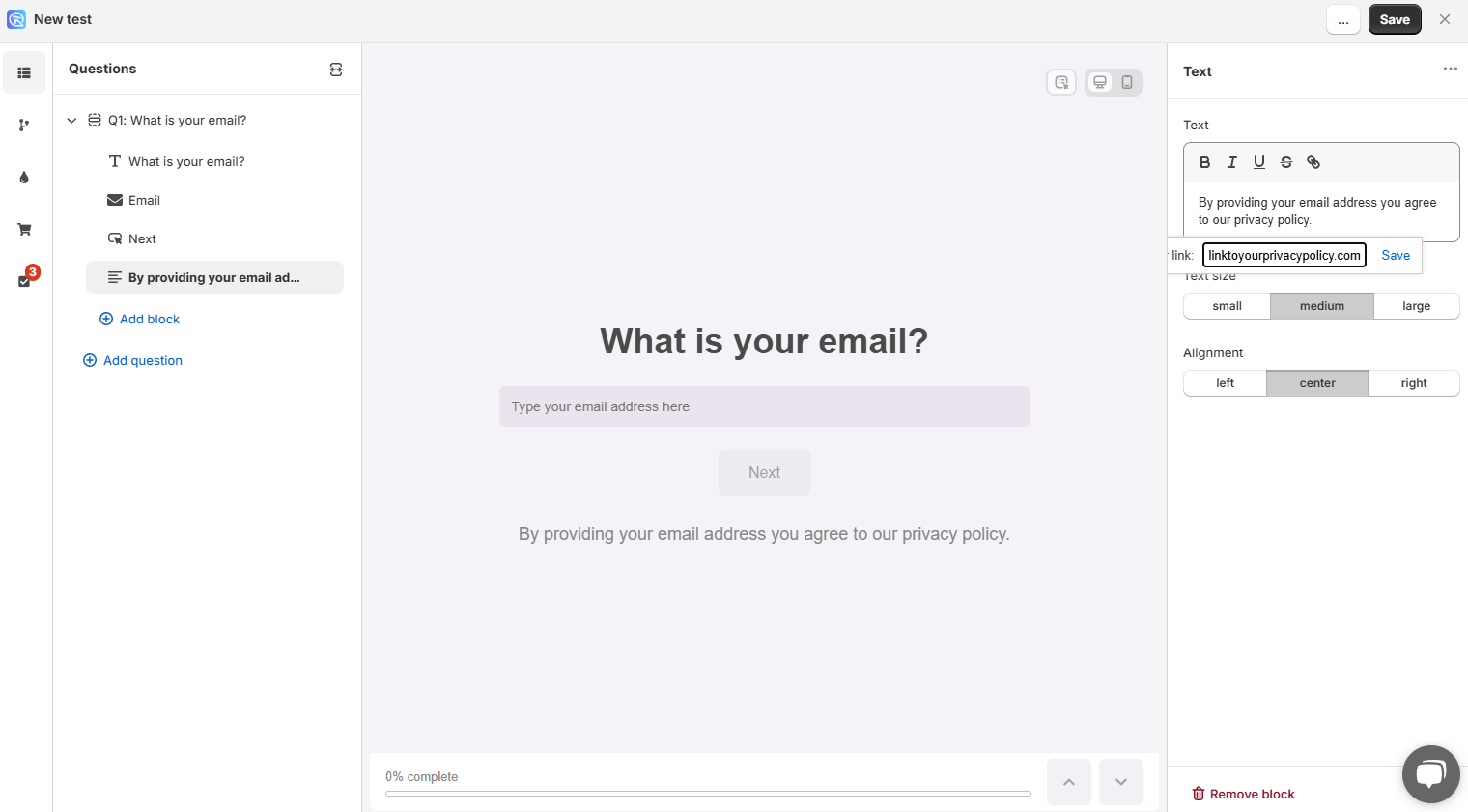
Consent starts with a privacy policy the customer can find. Link to it from any text element of the quiz with Markdown.
By providing your email address you agree to our [privacy policy](https://www.linktoyourprivacypolicy.com).
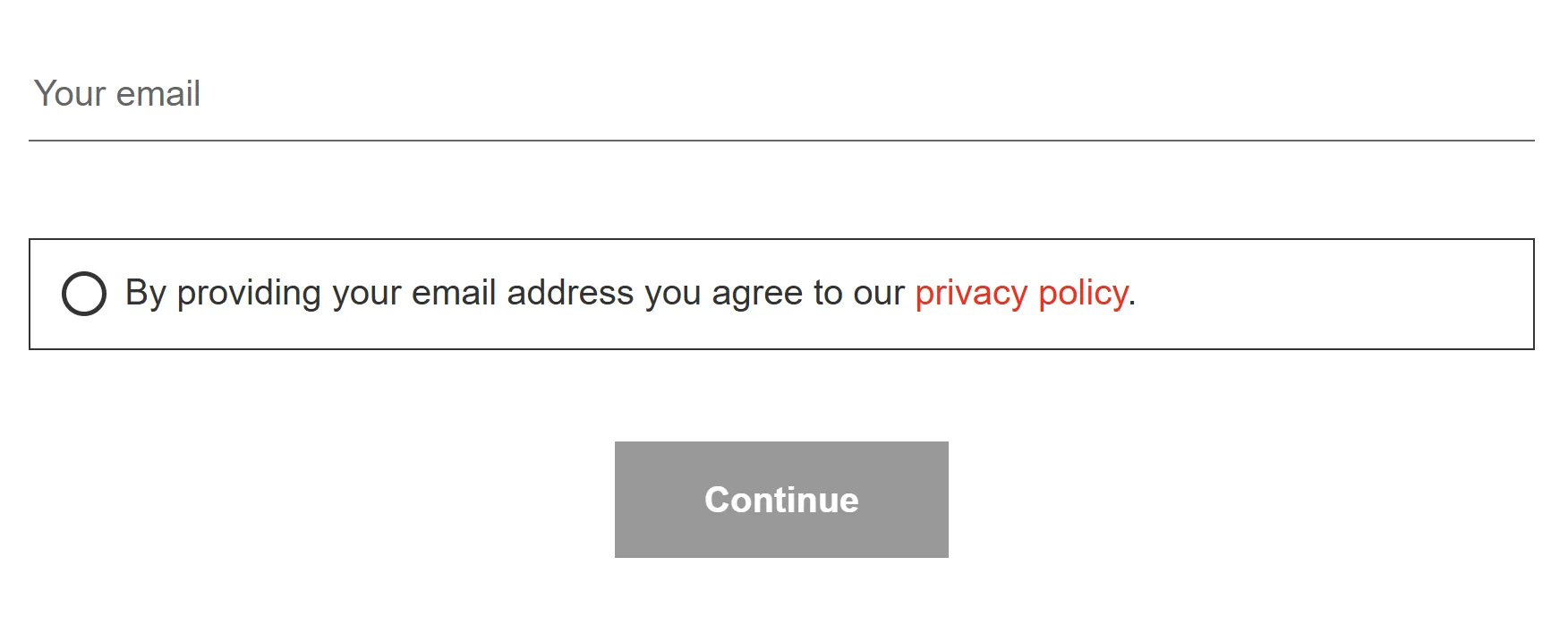
Consent starts with a privacy policy the customer can find. Link to it from any text element of the quiz with Markdown.
By providing your email address you agree to our [privacy policy](https://www.linktoyourprivacypolicy.com).
Consent starts with a privacy policy the customer can find. Link to it from any text element of the quiz with Markdown.
By providing your email address you agree to our [privacy policy](https://www.linktoyourprivacypolicy.com).
Consent starts with a privacy policy the customer can find. Link to it from any text element of the quiz with Markdown.
By providing your email address you agree to our [privacy policy](https://www.linktoyourprivacypolicy.com).
Consent starts with a privacy policy the customer can find. Link to it from any text element of the quiz with Markdown.
By providing your email address you agree to our [privacy policy](https://www.linktoyourprivacypolicy.com).
How to ask for marketing/data processing consent
Option 1: consent text on the question
Tell the customer, in a text block, that giving their email address means agreeing to receive marketing information.
-
Open the quiz builder and select the question that asks for the email address.
-
Click
+ Add blockand chooseText. -
Write your consent text into the field that appears.
-
Link your privacy policy with the link button in the text editor. For example,
[privacy policy](https://www.linktoyourprivacypolicy.com). -
Click the top-right
Savebutton.
Tell the customer, in the question description, that giving their email address means agreeing to receive marketing information.
-
Open the quiz builder, select the question that asks for the email address, and open its question settings.
-
Turn on
question description. -
Write your consent text into the field that appears.
-
Link your privacy policy with Markdown. For example,
[privacy policy](https://www.linktoyourprivacypolicy.com). -
Click the top-right
Publishbutton.
Tell the customer, in the question description, that giving their email address means agreeing to receive marketing information.
-
Open the quiz builder, select the question that asks for the email address, and open its question settings.
-
Turn on
question description. -
Write your consent text into the field that appears.
-
Link your privacy policy with Markdown. For example,
[privacy policy](https://www.linktoyourprivacypolicy.com). -
Click the top-right
Publishbutton.
Tell the customer, in the question description, that giving their email address means agreeing to receive marketing information.
-
Open the quiz builder, select the question that asks for the email address, and open its question settings.
-
Turn on
question description. -
Write your consent text into the field that appears.
-
Link your privacy policy with Markdown. For example,
[privacy policy](https://www.linktoyourprivacypolicy.com). -
Click the top-right
Publishbutton.
Tell the customer, in the question description, that giving their email address means agreeing to receive marketing information.
-
Open the quiz builder, select the question that asks for the email address, and open its question settings.
-
Turn on
question description. -
Write your consent text into the field that appears.
-
Link your privacy policy with Markdown. For example,
[privacy policy](https://www.linktoyourprivacypolicy.com). -
Click the top-right
Publishbutton.
Tell the customer, in the question description, that giving their email address means agreeing to receive marketing information.
-
Open the quiz builder, select the question that asks for the email address, and open its question settings.
-
Turn on
question description. -
Write your consent text into the field that appears.
-
Link your privacy policy with Markdown. For example,
[privacy policy](https://www.linktoyourprivacypolicy.com). -
Click the top-right
Publishbutton.
Option 2: marketing checkmark
Put a consent checkbox on the same slide as the email field, so the customer cannot go on without ticking it.
-
Open the quiz builder and select the question that holds the email block.
-
Click
+ Add blockand chooseMultiple Choice. -
Give it a single choice carrying your consent text, for example
I consent to process my data for marketing purposes.. -
Leave the block required. Turning
Optionalon would let the customer continue without consenting.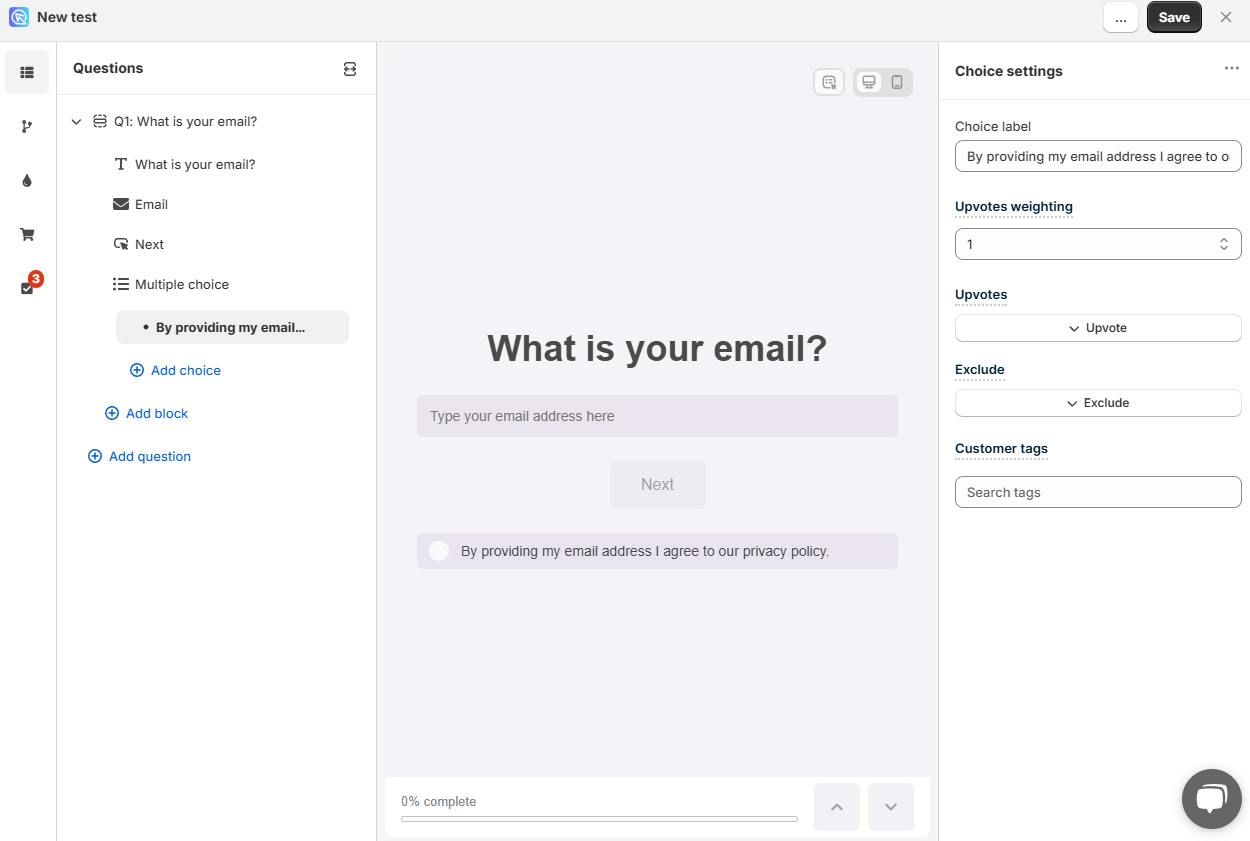
-
Click the top-right
Savebutton.
Both the email field and the consent choice now sit on one slide. See how to join questions for more on building a slide from several blocks.
Join two slides together to build a consent checkbox, so the customer cannot go on without ticking it.
-
Open the quiz builder and add a
Multiple Choicequestion straight after the email or phone question. -
Give it a single choice carrying your consent text, for example
I consent to process my data for marketing purposes.. -
Go back to the email or phone question and open its question settings.
-
Turn on
Join next question. The two questions then share one slide, and the customer has to select the consent choice to continue.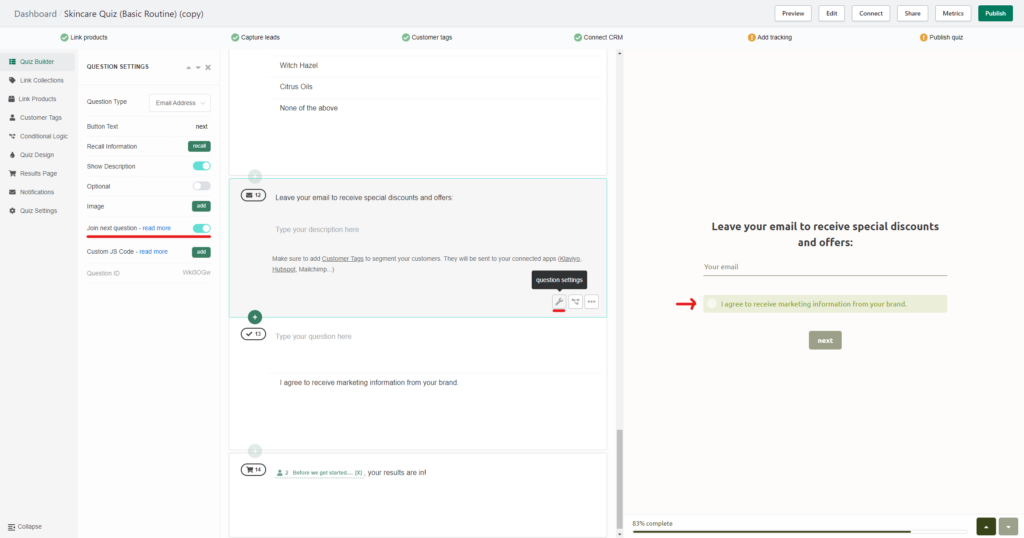
-
Click the top-right
Publishbutton.
See how to join questions for more on joining slides.
Join two slides together to build a consent checkbox, so the customer cannot go on without ticking it.
-
Open the quiz builder and add a
Multiple Choicequestion straight after the email or phone question. -
Give it a single choice carrying your consent text, for example
I consent to process my data for marketing purposes.. -
Go back to the email or phone question and open its question settings.
-
Turn on
Join next question. The two questions then share one slide, and the customer has to select the consent choice to continue. -
Click the top-right
Publishbutton.
See how to join questions for more on joining slides.
Join two slides together to build a consent checkbox, so the customer cannot go on without ticking it.
-
Open the quiz builder and add a
Multiple Choicequestion straight after the email or phone question. -
Give it a single choice carrying your consent text, for example
I consent to process my data for marketing purposes.. -
Go back to the email or phone question and open its question settings.
-
Turn on
Join next question. The two questions then share one slide, and the customer has to select the consent choice to continue. -
Click the top-right
Publishbutton.
See how to join questions for more on joining slides.
Join two slides together to build a consent checkbox, so the customer cannot go on without ticking it.
-
Open the quiz builder and add a
Multiple Choicequestion straight after the email or phone question. -
Give it a single choice carrying your consent text, for example
I consent to process my data for marketing purposes.. -
Go back to the email or phone question and open its question settings.
-
Turn on
Join next question. The two questions then share one slide, and the customer has to select the consent choice to continue. -
Click the top-right
Publishbutton.
See how to join questions for more on joining slides.
Join two slides together to build a consent checkbox, so the customer cannot go on without ticking it.
-
Open the quiz builder and add a
Multiple Choicequestion straight after the email or phone question. -
Give it a single choice carrying your consent text, for example
I consent to process my data for marketing purposes.. -
Go back to the email or phone question and open its question settings.
-
Turn on
Join next question. The two questions then share one slide, and the customer has to select the consent choice to continue. -
Click the top-right
Publishbutton.
See how to join questions for more on joining slides.
Option 3: GDPR question
A Legal Terms/GDPR question is a slide of its own, showing your terms with an accept and a decline button.
-
Open the quiz builder and click
+ Add question. -
Choose
Legal Terms/GDPR. -
Ask, in the question text, whether the customer consents to their data being processed for marketing.
-
Click the top-right
Savebutton.
Segment on the answer straight away
Jump logic can send a customer who accepts down a different path from one who declines.
A Legal Terms/GDPR question is a slide of its own, showing your terms with an accept and a decline button.
-
Open the quiz builder and click
+/Add new question. -
Choose
Legal Terms/GDPR. -
Ask, in the question text, whether the customer consents to their data being processed for marketing.
-
Click the top-right
Publishbutton.
Segment on the answer straight away
Jump logic can send a customer who accepts down a different path from one who declines.
A Legal Terms/GDPR question is a slide of its own, showing your terms with an accept and a decline button.
-
Open the quiz builder and click
+/Add new question. -
Choose
Legal Terms/GDPR. -
Ask, in the question text, whether the customer consents to their data being processed for marketing.
-
Click the top-right
Publishbutton.
Segment on the answer straight away
Jump logic can send a customer who accepts down a different path from one who declines.
A Legal Terms/GDPR question is a slide of its own, showing your terms with an accept and a decline button.
-
Open the quiz builder and click
+/Add new question. -
Choose
Legal Terms/GDPR. -
Ask, in the question text, whether the customer consents to their data being processed for marketing.
-
Click the top-right
Publishbutton.
Segment on the answer straight away
Jump logic can send a customer who accepts down a different path from one who declines.
A Legal Terms/GDPR question is a slide of its own, showing your terms with an accept and a decline button.
-
Open the quiz builder and click
+/Add new question. -
Choose
Legal Terms/GDPR. -
Ask, in the question text, whether the customer consents to their data being processed for marketing.
-
Click the top-right
Publishbutton.
Segment on the answer straight away
Jump logic can send a customer who accepts down a different path from one who declines.
A Legal Terms/GDPR question is a slide of its own, showing your terms with an accept and a decline button.
-
Open the quiz builder and click
+/Add new question. -
Choose
Legal Terms/GDPR. -
Ask, in the question text, whether the customer consents to their data being processed for marketing.
-
Click the top-right
Publishbutton.
Segment on the answer straight away
Jump logic can send a customer who accepts down a different path from one who declines.
This article explains three ways to ask for marketing or data processing consent in a quiz. They are consent text on the question, a marketing checkmark, and a Legal Terms/GDPR question.