How to Send Quiz Leads to Shopify Customers
You can add new customers automatically to your Shopify Customers list every time someone completes the quiz. Once someone leaves their email in the quiz, their Shopify Customer profile will be updated with their name, email, phone number and customer tags.
This article explains how to connect your quiz to Shopify Customers and tag each customer by their answers. It also covers building a Shopify Flow that acts on those tags.
Link quiz to Shopify Customers
Before you begin
Make sure your quiz has an email question. Without one, the app cannot send anything to Shopify Customers or Shopify Flow.
(optional) Tag choices with customer tags. Customer tags are copied to the Shopify Customer profile, where you can use them for retargeting.
- Open App settings from the side menu.
- Click the
Shopify Customerstab. -
Turn on
Enable pushing quiz leads to Shopify Customers.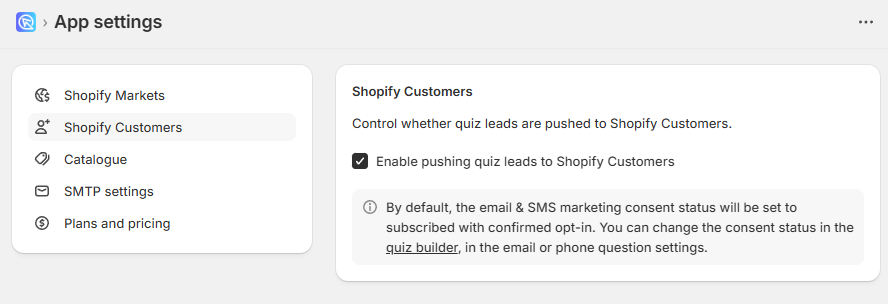
-
Click
Save.
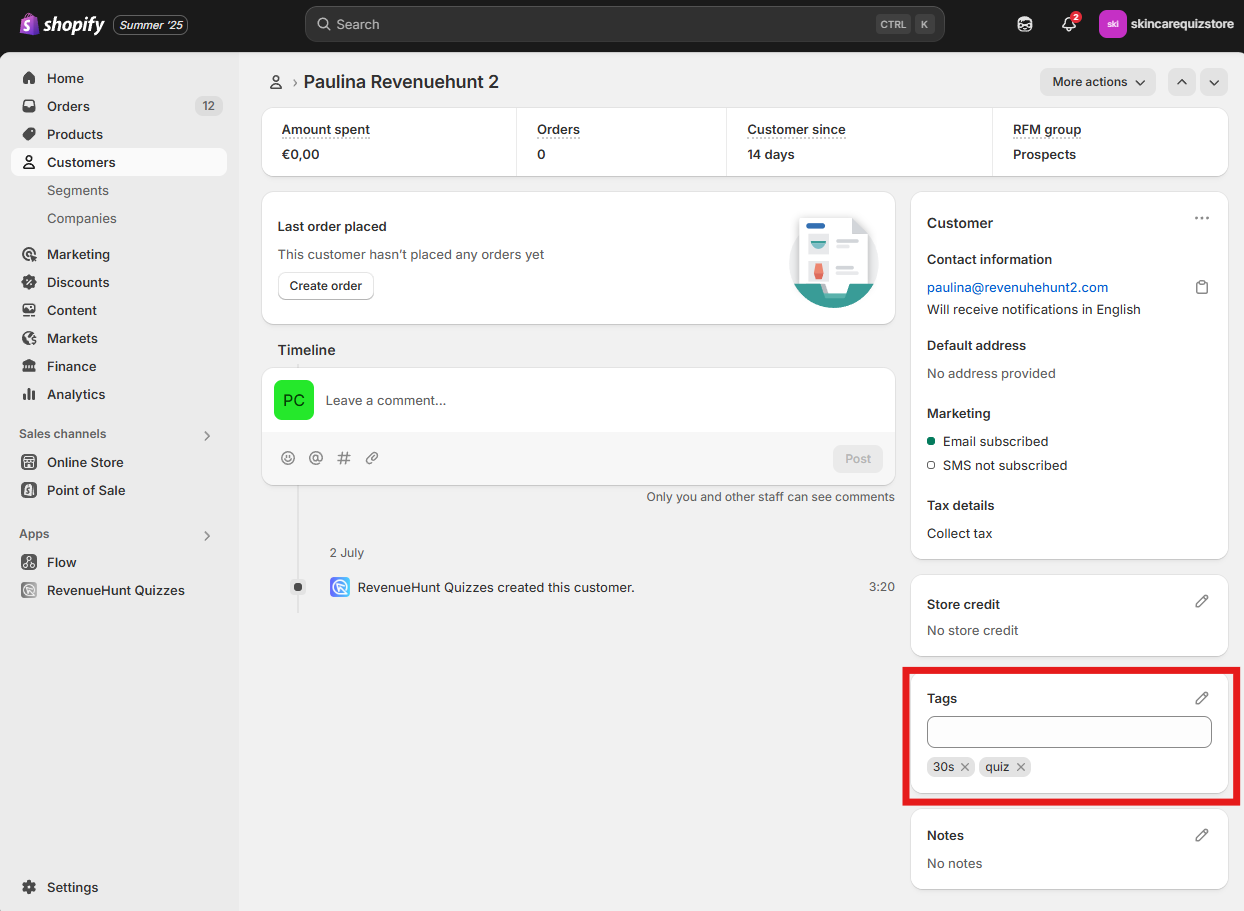
New leads then appear in your Shopify Customers list, with their customer tags on the profile.
Note
This is a global setting that applies to all quizzes in your shop.
Note
If a profile with the same email already exists, it will be updated with the customer tags from the quiz.
Customer tags are added every time a customer takes the quiz. Tags from previous attempts are kept, so a customer who retakes the quiz and picks different answers will hold the tags from both attempts.
Note
Customer tags are sent to Shopify exactly as you named them in the quiz builder, with no prefix added. A choice tagged teen appears on the Shopify profile as teen. Use that same name when you reference the tag in a Shopify Flow condition.
- Open your quiz and go to the
Connecttab at the top of the screen. It lists the third-party services you can connect to. - Click
Connectin theShopify Customerssection. This authorizes the app to write to your Shopify Customers list. - Click
Publishto save the changes and update the preview and the live quiz.
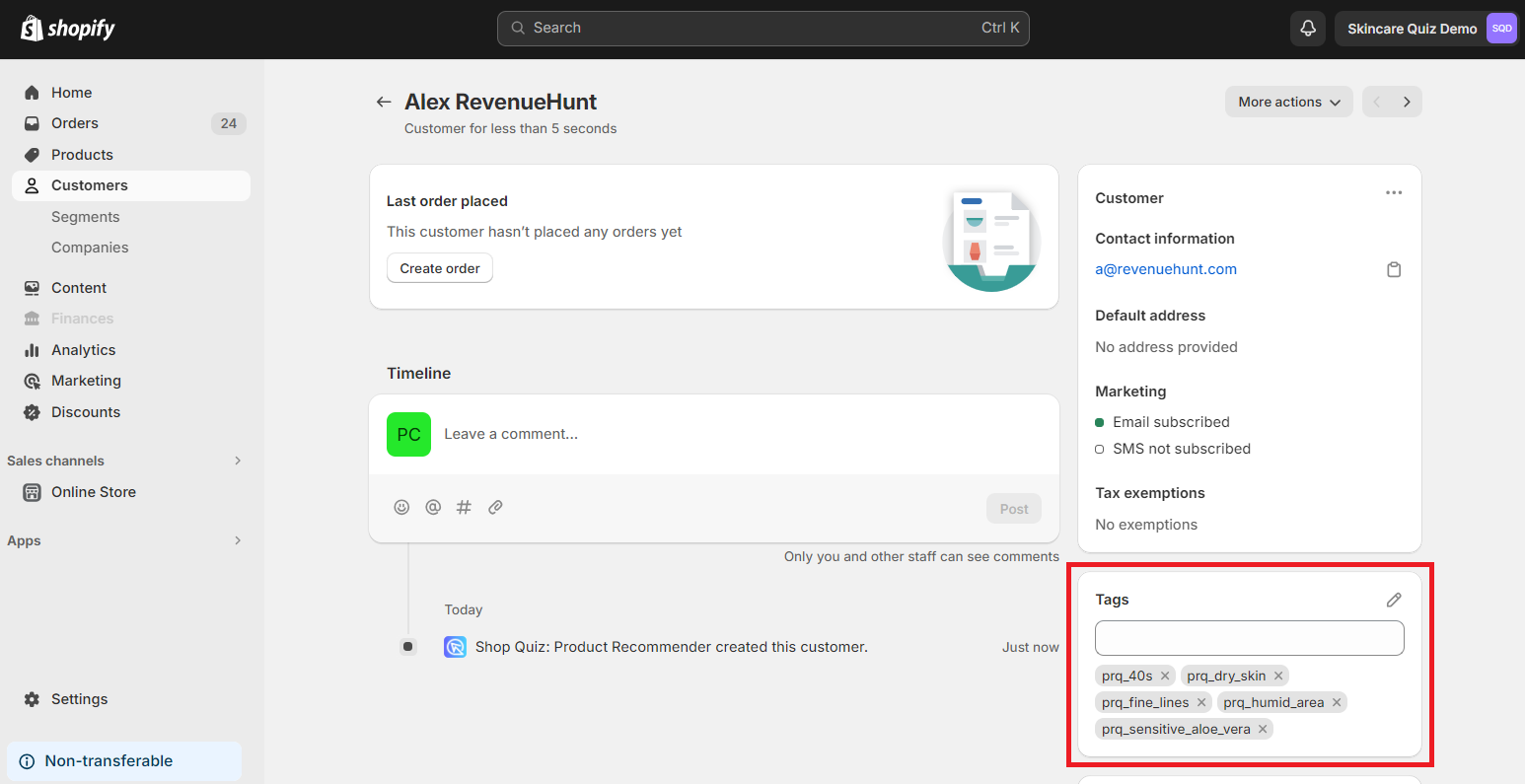
New leads then appear in your Shopify Customers list, with their Customer Tags on the profile.
Note
If a profile with the same email already exists, it will be updated with the customer tags from the quiz.
Customer tags are updated every time a customer takes the quiz.
Note
Tags coming from the quiz carry a prq_ prefix. A choice tagged teen in the quiz builder appears on the Shopify profile as prq_teen.
Not available on this platform
Shopify Customers is a Shopify feature, so this platform has no such list for the quiz to write to. To collect quiz leads here, connect a CRM or a mailing list instead. See how to send quiz leads to your CRM.
Not available on this platform
Shopify Customers is a Shopify feature, so this platform has no such list for the quiz to write to. To collect quiz leads here, connect a CRM or a mailing list instead. See how to send quiz leads to your CRM.
Not available on this platform
Shopify Customers is a Shopify feature, so this platform has no such list for the quiz to write to. To collect quiz leads here, connect a CRM or a mailing list instead. See how to send quiz leads to your CRM.
Not available on this platform
Shopify Customers is a Shopify feature, so this platform has no such list for the quiz to write to. To collect quiz leads here, connect a CRM or a mailing list instead. See how to send quiz leads to your CRM.
What data is sent to Shopify Customers?
When someone completes the quiz and leaves their email address, the app creates or updates a customer in your Shopify admin with the data below.
| Field | Value |
|---|---|
email |
The customer's email address, used to match or create the profile. |
firstName |
The customer's first name. |
lastName |
The customer's last name. |
phone |
The customer's phone number. |
| Tags | All tags assigned in the quiz, added to the customer's Shopify tags. |
emailMarketingConsent |
Set to SUBSCRIBED when the customer gives email marketing consent in the quiz. |
smsMarketingConsent |
Set to SUBSCRIBED when a phone number is provided and the customer gives SMS consent. |
Opt-in level
Whether the subscription is recorded as single or confirmed opt-in depends on your settings in the quiz editor. See Change subscribed/consent status and how to ask for marketing consent.
Shopify Flow receives much more
The customer profile holds identity, tags and consent only. The Quiz Completed trigger for Shopify Flow carries the whole response. That means every answer with its question title, block reference and choice references. It also carries the variable scores, the results page, and each recommended product with its product and variant GIDs, price, URL, rank and slot. See What data is sent for the complete field list.
| Field | Value |
|---|---|
email |
The customer's email address, used to match or create the profile. |
first_name |
The customer's first name. |
last_name |
The customer's last name. |
phone |
The customer's phone number. |
| Tags | All tags assigned in the quiz, appended with the prq_ prefix, for example prq_Oily-Skin. |
accepts_marketing |
Set to true. |
Metafield prq.response_permalink |
URL of the customer's most recent results page. |
Quiz tags are refreshed on every completion
The app finds the existing tags carrying the prq_ prefix and replaces them with the tags from the newest response. The profile therefore holds the customer's most recent answers, rather than the tags from every retake.
No native Shopify Flow trigger
The legacy version has no Quiz Completed trigger. To automate on quiz completions you have two options:
- Trigger on customer tags. Use Shopify's
Customer tags addedtrigger and match one of theprq_tags. See Set up Shopify Flow. - Use Zapier. Connect the quiz to Zapier, which receives the full response and can act on it or push data back to Shopify.
Not available on this platform
Shopify Customers is a Shopify feature, so this platform has no such list for the quiz to write to. To collect quiz leads here, connect a CRM or a mailing list instead. See how to send quiz leads to your CRM.
Not available on this platform
Shopify Customers is a Shopify feature, so this platform has no such list for the quiz to write to. To collect quiz leads here, connect a CRM or a mailing list instead. See how to send quiz leads to your CRM.
Not available on this platform
Shopify Customers is a Shopify feature, so this platform has no such list for the quiz to write to. To collect quiz leads here, connect a CRM or a mailing list instead. See how to send quiz leads to your CRM.
Not available on this platform
Shopify Customers is a Shopify feature, so this platform has no such list for the quiz to write to. To collect quiz leads here, connect a CRM or a mailing list instead. See how to send quiz leads to your CRM.
Legacy vs Built for Shopify: what reaches Shopify
| Feature | Legacy | Built for Shopify |
|---|---|---|
| Customer tags | Appended with the prq_ prefix, and old prefixed tags are reset on each completion |
Appended directly, with no prefix |
| Metafields | Saves the results permalink to the prq.response_permalink metafield |
Does not write to metafields |
| Shopify Flow | No native trigger, so trigger on customer tags or use Zapier | Native Quiz Completed trigger carrying the full response |
| Consent | Simple accepts_marketing: true |
SUBSCRIBED status for email and SMS, with opt-in levels |
Change subscribed/consent status for email and phone questions
A contact the quiz adds to the Shopify Customers list is marked as subscribed by default. Change that on the email block.
- Open the quiz builder and select the
Emailblock. TheEmail input settingspanel opens. - Scroll to the
Shopify Customerssection. - Set
Subscribed. Tick it to record consent to marketing, or clear it to add the contact without that consent. - Choose the
Opt-in levelyou need. -
Click the top-right
Savebutton.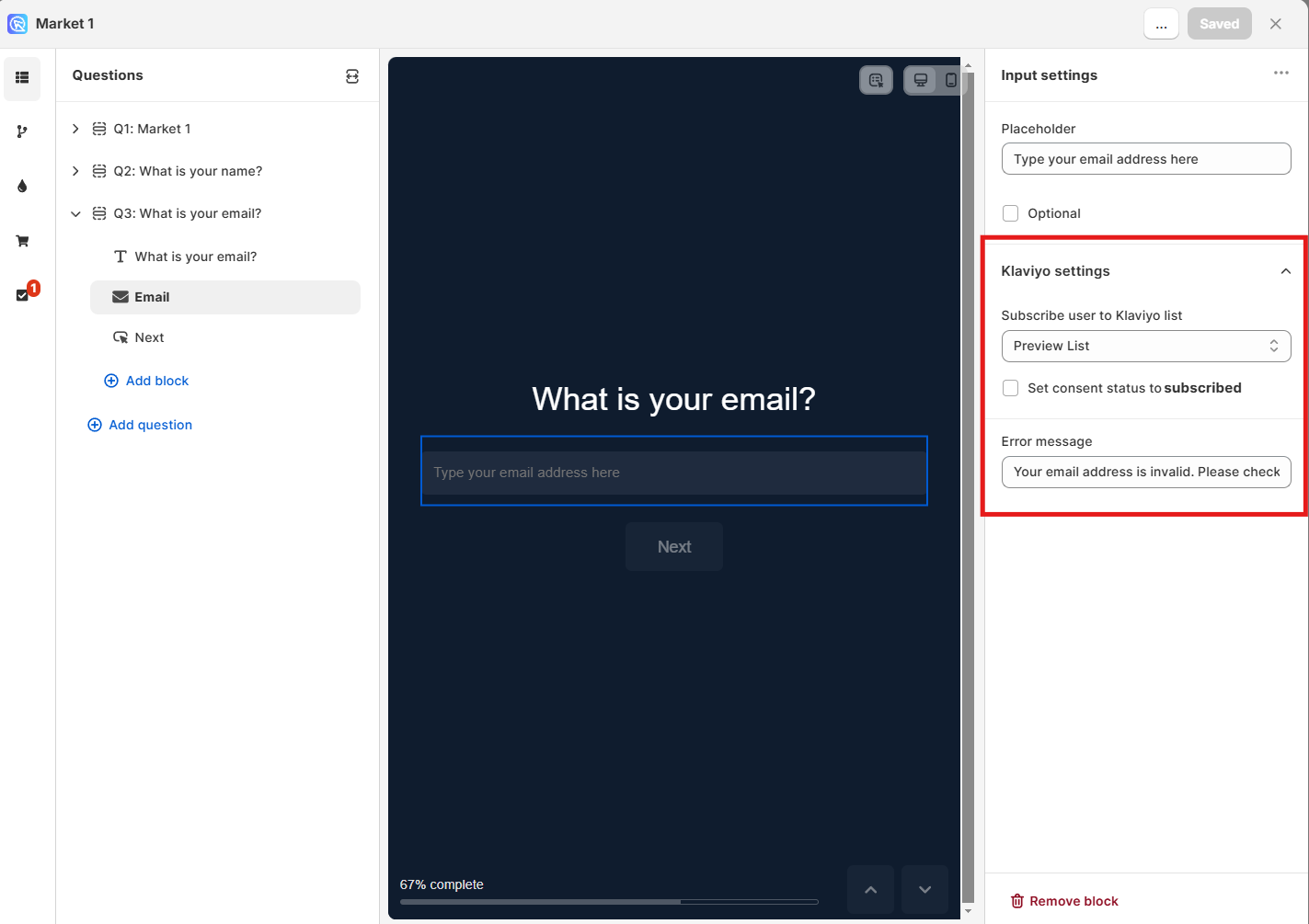
Tip
how to ask for marketing/data processing consent covers asking the customer for consent inside the quiz itself.
Every contact the quiz adds to the list is marked as subscribed, with consent to marketing recorded. Change that in the email and phone question settings.
- Open the email or phone question in the Quiz Builder.
-
Open the question settings and set
Consent stateandOpt-in level.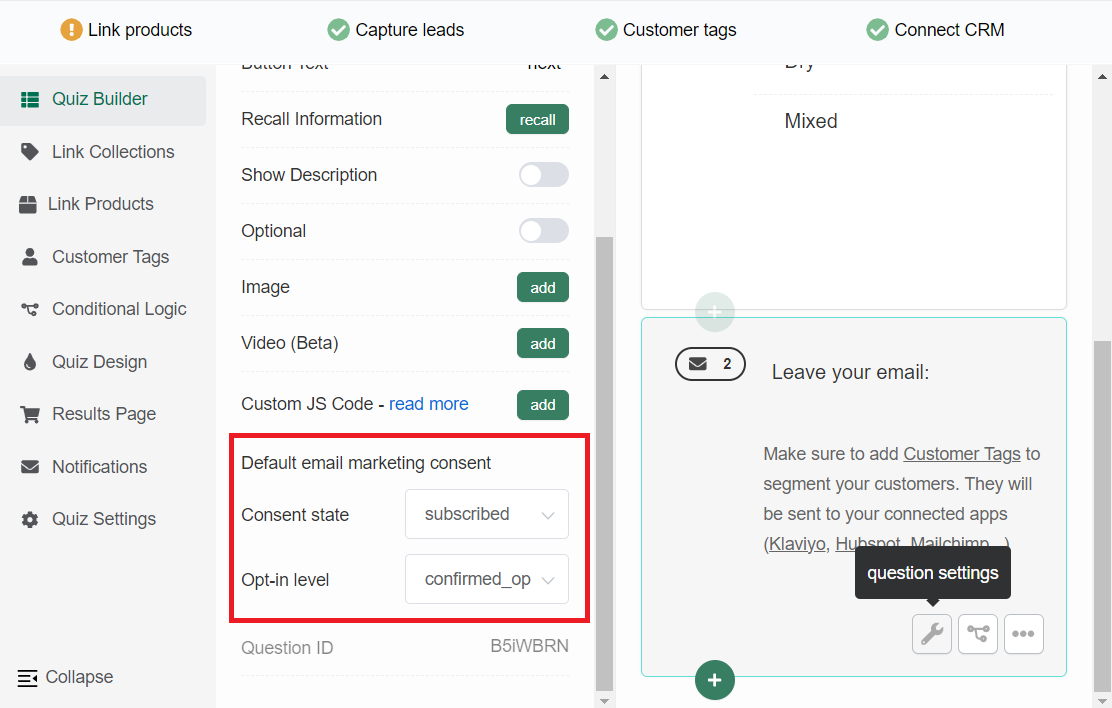
-
Under
Consent state, you can select eithersubscribedornon-subscribed. -
Under
Opt-in level, you can select eitherconfirmed_opt_inorsingle_opt_in(pick this option if you only want to send the one results email to the customer).
-
-
Click
Publishto update the preview and the live quiz.
Not available on this platform
Shopify Customers is a Shopify feature, so this platform has no such list for the quiz to write to. To collect quiz leads here, connect a CRM or a mailing list instead. See how to send quiz leads to your CRM.
Not available on this platform
Shopify Customers is a Shopify feature, so this platform has no such list for the quiz to write to. To collect quiz leads here, connect a CRM or a mailing list instead. See how to send quiz leads to your CRM.
Not available on this platform
Shopify Customers is a Shopify feature, so this platform has no such list for the quiz to write to. To collect quiz leads here, connect a CRM or a mailing list instead. See how to send quiz leads to your CRM.
Not available on this platform
Shopify Customers is a Shopify feature, so this platform has no such list for the quiz to write to. To collect quiz leads here, connect a CRM or a mailing list instead. See how to send quiz leads to your CRM.
Tag quiz choices to segment Shopify Customers
Use Customer tags to carry a customer's answers onto their Shopify Customer profile.
-
Add tags to your quiz choices.
- Open the RevenueHunt app and select your quiz.
- Navigate to the choice settings section.
- Under Customer tags, create new tags for each choice. For example, create a tag called
teenand assign it to the relevant choice. - Repeat for the other choices, for example tagging another with
30s. - Add one common tag, such as
quiz, to every choice in a single question. Everyone who finishes the quiz then carries that tag.
-
Click
Save. Previewthe quiz and finish it, using the same email or a new one.- Refresh the Shopify Customers list to see the new lead arrive.
- Open the customer's profile and check their name, email and the tags from the quiz.
You can then use these tags to create a Shopify email Flow.
Use Customer Tags to carry a customer's answers onto their Shopify Customer profile.
-
Add tags to your quiz choices.
- Open the RevenueHunt app and select your quiz.
- Navigate to the Customer Tags section.
- Create new tags for each choice. For example, create a tag called
teenand assign it to the relevant choice. - Repeat for the other choices, tagging them
30s,40s,50s,60s,dry skin,oily skinand so on. - Add one common tag, such as
quiz, to every choice in a single question. Everyone who finishes the quiz then carries that tag.
-
Click
Publish. Previewthe quiz and finish it, using the same email or a new one.- Refresh the Shopify Customers list to see the new lead arrive.
- Open the customer's profile and check their name, email and the tags from the quiz.
Note
Tags coming from the quiz carry a prq_ prefix. A choice tagged teen in the quiz builder appears on the Shopify profile as prq_teen.
You can then use these tags to create a Shopify email Flow.
Not available on this platform
Shopify Customers is a Shopify feature, so this platform has no such list for the quiz to write to. To collect quiz leads here, connect a CRM or a mailing list instead. See how to send quiz leads to your CRM.
Not available on this platform
Shopify Customers is a Shopify feature, so this platform has no such list for the quiz to write to. To collect quiz leads here, connect a CRM or a mailing list instead. See how to send quiz leads to your CRM.
Not available on this platform
Shopify Customers is a Shopify feature, so this platform has no such list for the quiz to write to. To collect quiz leads here, connect a CRM or a mailing list instead. See how to send quiz leads to your CRM.
Not available on this platform
Shopify Customers is a Shopify feature, so this platform has no such list for the quiz to write to. To collect quiz leads here, connect a CRM or a mailing list instead. See how to send quiz leads to your CRM.
Set up Shopify Flow
Shopify Flow runs an automation after someone takes your quiz. There are two ways to start that workflow.
Recommended: start from the quiz completion.
The Quiz Completed trigger starts a workflow every time a customer finishes the quiz and leaves an email address. It carries the quiz data with it. Your conditions and actions can therefore read the answers, the recommended products, the customer tags and the variable scores.
- Check that your quiz has an email question and that
Enable pushing quiz leads to Shopify Customersis on. Without both, nothing reaches Flow. See Link quiz to Shopify Customers. - Install Shopify Flow if your store does not have it yet. It is free.
- Open Shopify Flow and click
Create workflow. - Click
Select a trigger, chooseProduct Recommendation Quiz, thenQuiz Completed. -
Add the conditions and actions you want to run after a completion. Wherever a field accepts a variable, click
Add variableto pull in the quiz data.Info
For every field the trigger makes available, including the answers, recommendations and variable scores, see What data is sent.
-
Click
Turn on workflow. - Complete your published quiz with an email address, then reopen the workflow and check its recent runs.
RevenueHunt reports whether Shopify has seen an active workflow in App Settings > Shopify Customers > Shopify Flow.
Tip
For worked examples, see Automate Quiz Completions with Shopify Flow. It covers emailing your team with the quiz results in the message, and branching on a customer tag.
Alternative: start from a customer tag.
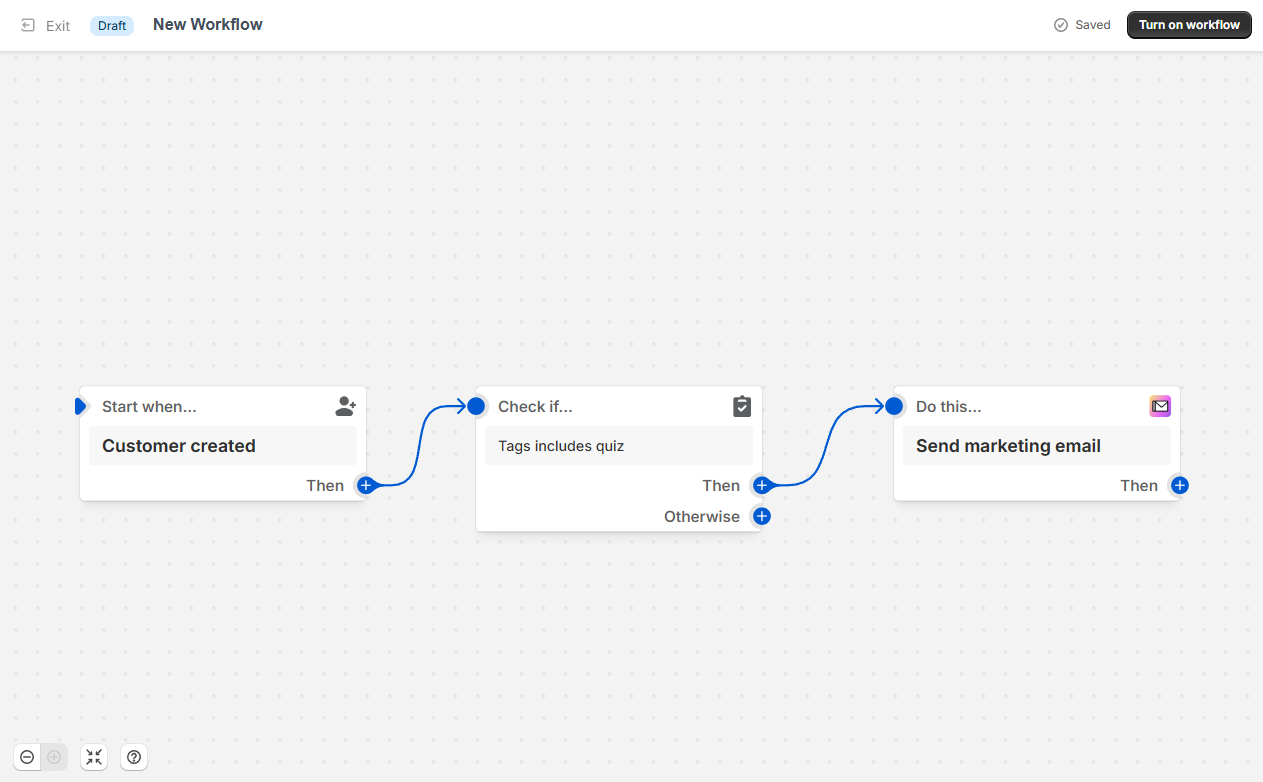
This is the older approach. It uses Shopify's Customer created trigger with a condition on customer tags. It therefore runs only for brand new customers, and it cannot read the quiz answers or recommendations. Use it to act on first-time customers only, or when you already have an automation built this way that still does what you need.
- Open the automations list: go to
Apps > Messaging > Automationsin your Shopify admin and clickCreate automation. Older stores may still reach the same screen fromMarketing > Automations > View templates. - Select
Create custom automation.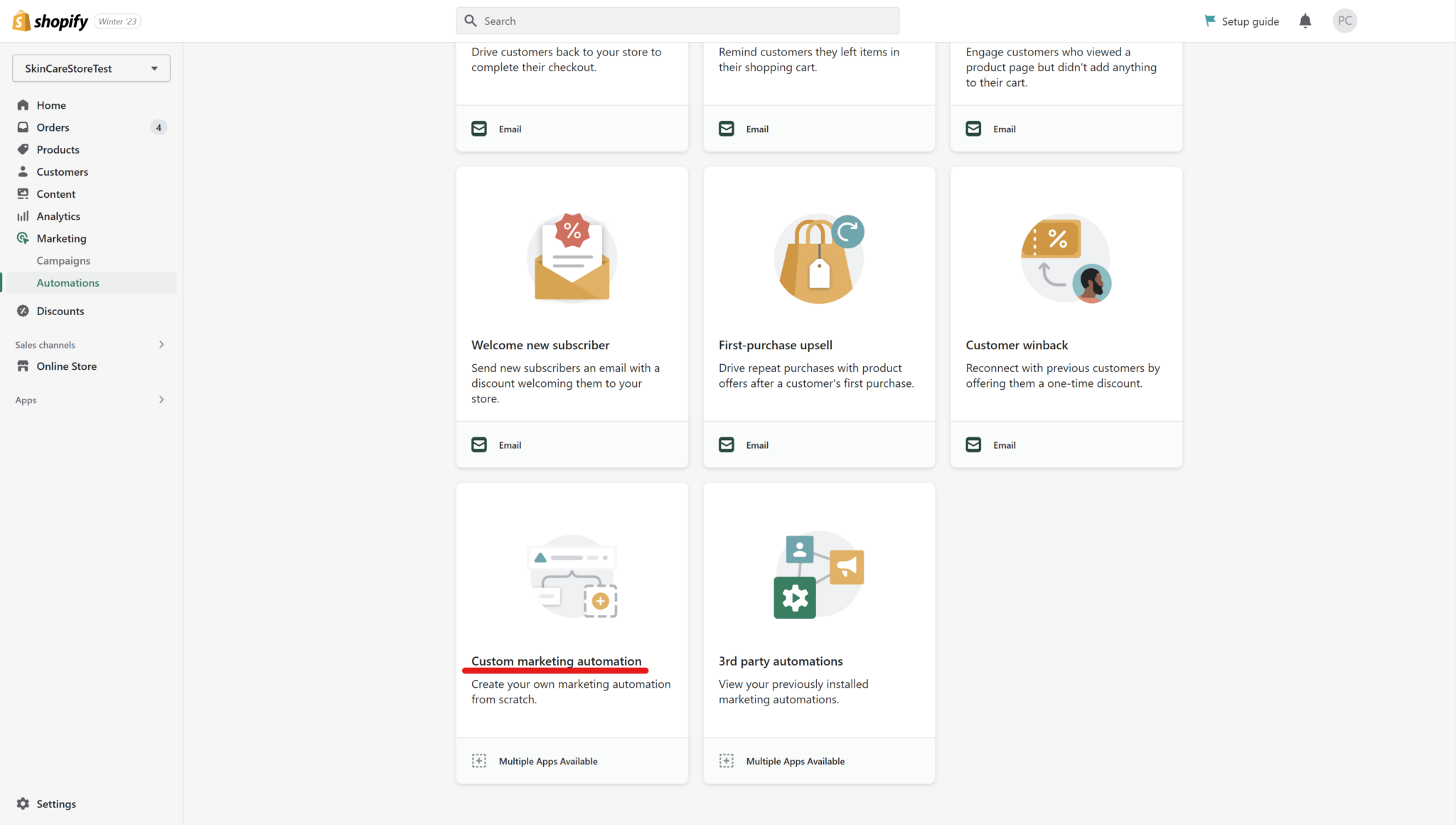
-
Add a trigger: Click anywhere and select the first trigger to be
Customer created.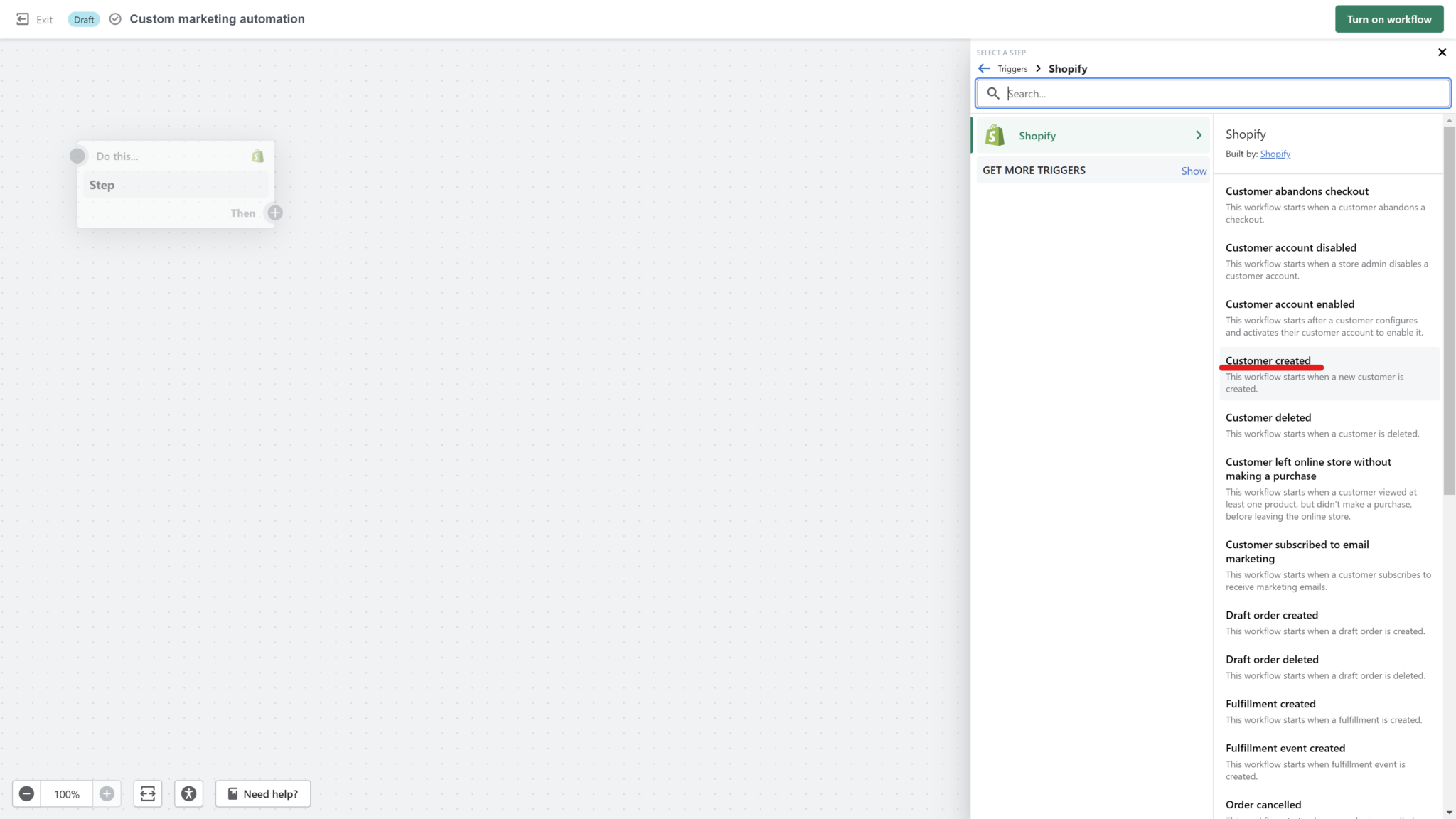
This fires only for brand new customers. A customer who already exists in your Shopify Customers list is updated rather than created, so the automation does not run for them.
-
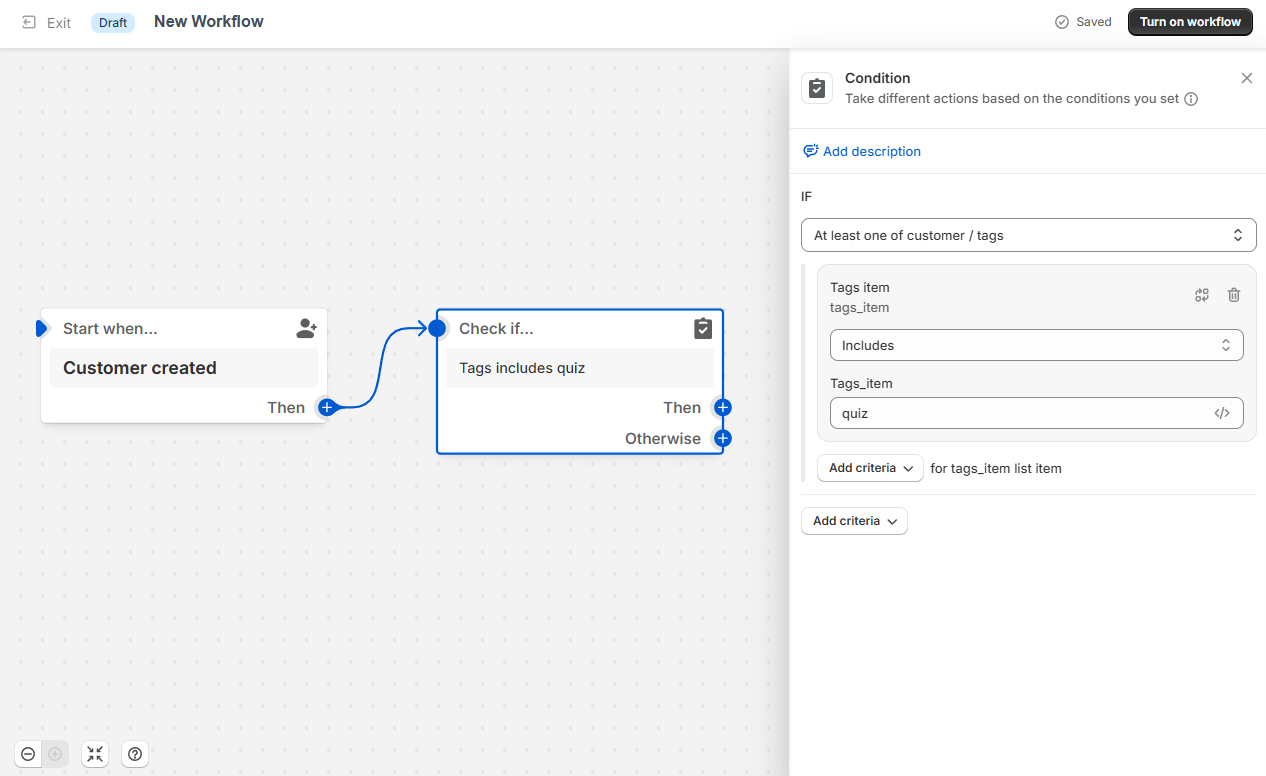
Select a condition: Add a
Conditionaction after the trigger. ClickAdd variableand from the list look forcustomerand thentags. Then, set up the condition as follows:At least one customer / tags
includestags_itemquiz.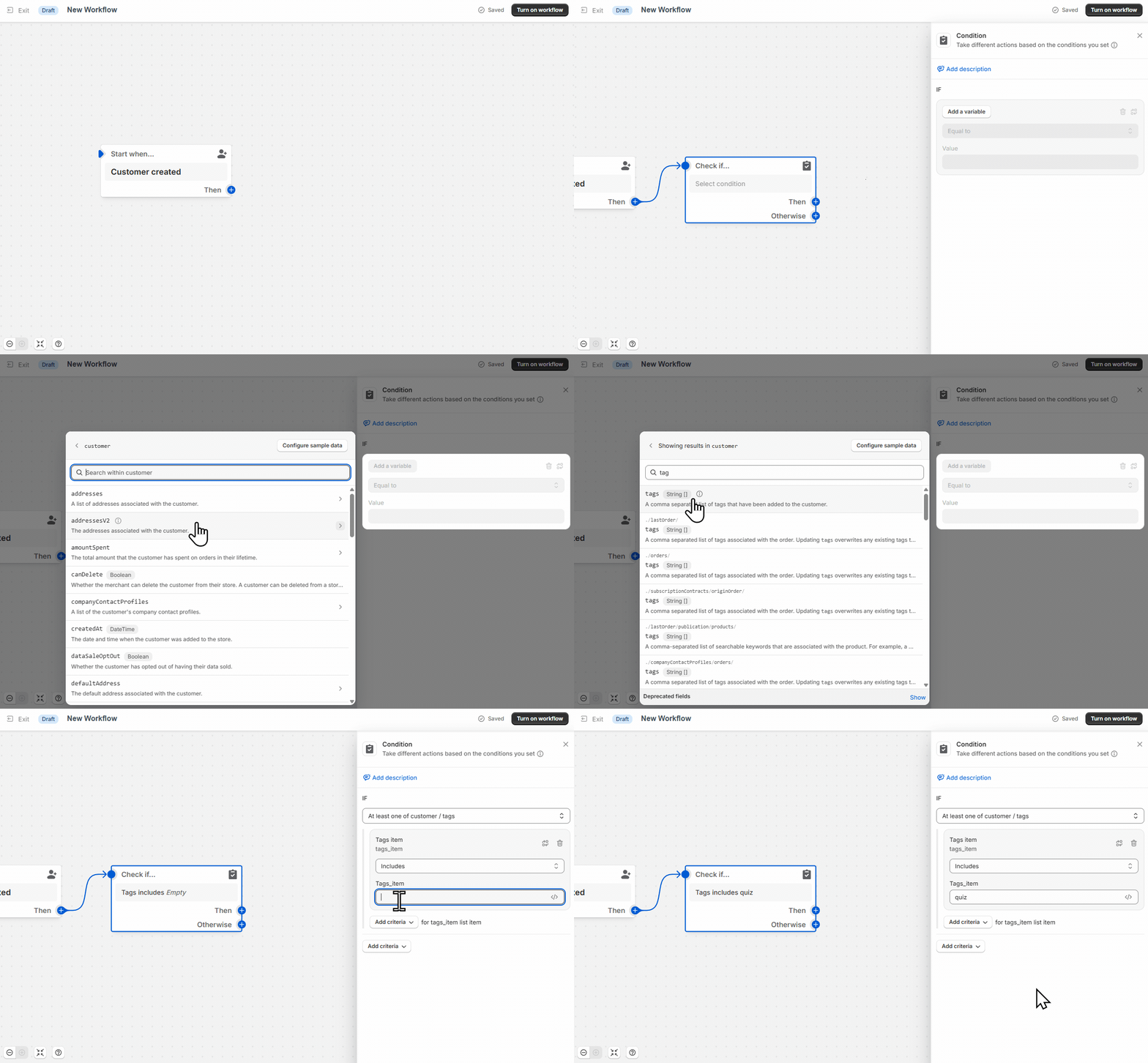
Type the tag exactly as you named it in the quiz builder.
-
Set up an email: click
Then > Actionand selectSend marketing email. Then pick the email template you want. The email goes to every contact carrying the tag, as soon as the tag lands on their profile.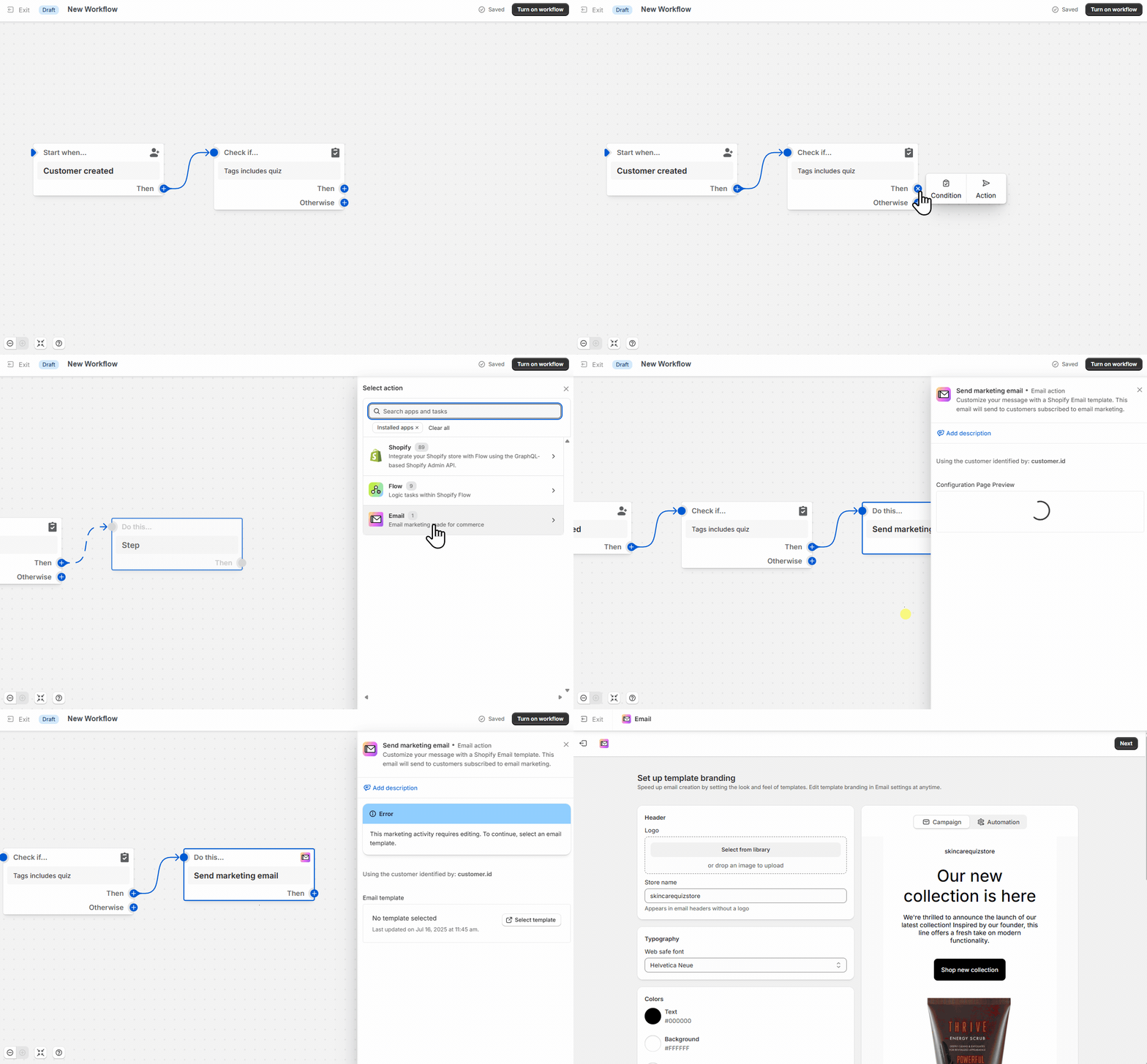
- Save: click
Turn on workflowwhen you have finished.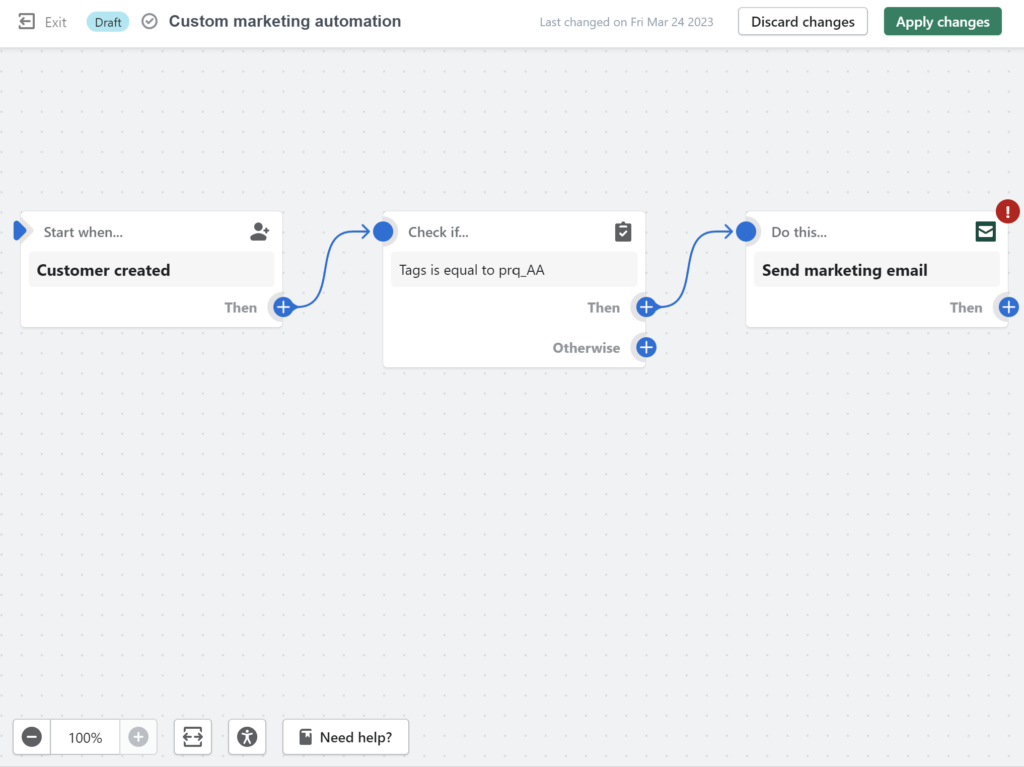
- Test it: complete your published quiz with an email address that is not yet in your Shopify Customers list. Then open the automation and check its recent runs.
Every customer carrying that tag is then sent the marketing email.
Note
Since 24 March 2026, marketing automations that use Shopify Messaging emails are managed in the Shopify Messaging app, under Apps > Messaging > Automations. Automations whose marketing action comes from another email app, such as Klaviyo or Seguno, remain in the Shopify Flow app. Existing automations kept working through the move, so you do not need to rebuild anything.
Send marketing email is not a built-in Shopify Flow action. Your installed email app provides it, and it reaches only customers subscribed to marketing. Quiz leads are subscribed by default. See Change subscribed and consent status.
To learn more about Shopify Automations, check their FAQ page.
- Go to
Apps > Messaging > Automationsin your Shopify admin and clickCreate automation. Older stores may still reach the same screen fromMarketing > Automations > View templates. - Select
Create custom automation. - Add a trigger: Click anywhere and select the first trigger to be
Customer created. -
Select a condition: Add a
Conditionaction after the trigger. ClickAdd variableand from the list look forcustomerand thentags. Then, set up the condition as follows:At least one customer / tags
includestags_itemprq_quiz.Note
You need to add the full name of the tag. For example,
prq_oilyskinorprq_Oily Skin.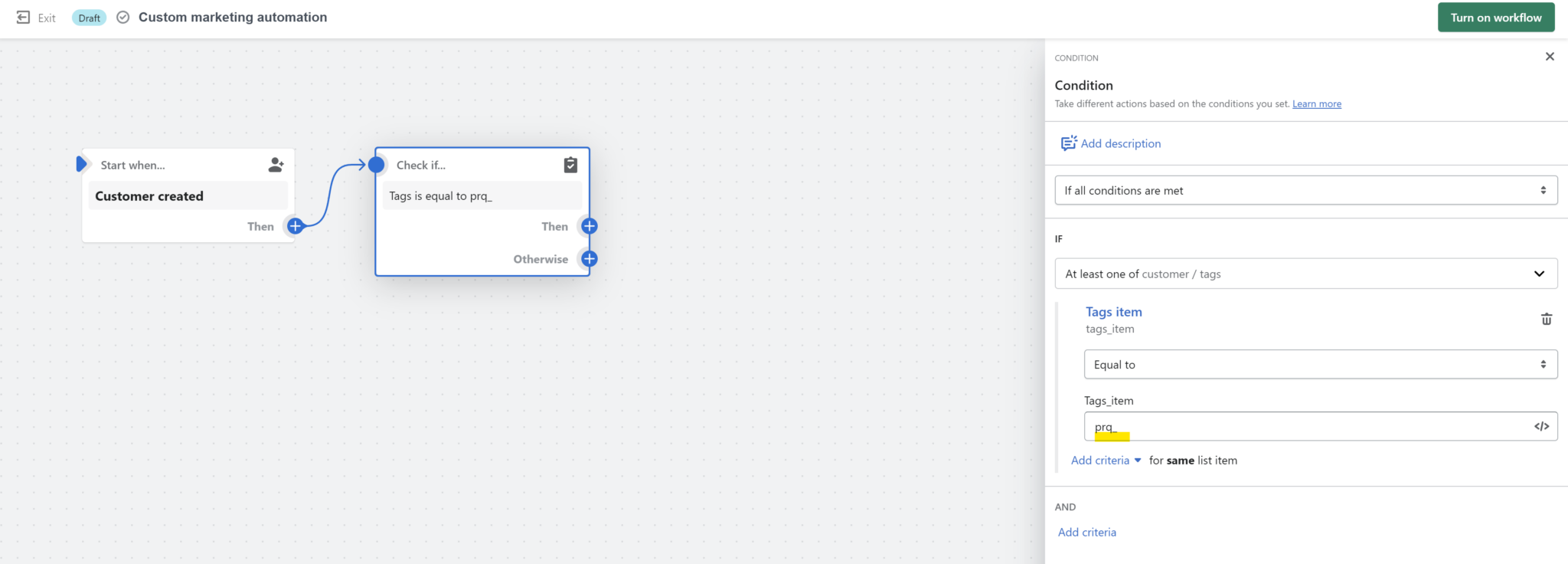
-
Set up an email: click
Then > Actionand selectSend marketing email. Then pick the email template you want. The email goes to every contact carrying theprq_tag, as soon as the tag lands on their profile. - Save: click
Turn on workflowwhen you have finished.
Every customer carrying that prq_ tag is then sent the marketing email.
To learn more about Shopify Automations, check their FAQ page.
Not available on this platform
Shopify Customers is a Shopify feature, so this platform has no such list for the quiz to write to. To collect quiz leads here, connect a CRM or a mailing list instead. See how to send quiz leads to your CRM.
Not available on this platform
Shopify Customers is a Shopify feature, so this platform has no such list for the quiz to write to. To collect quiz leads here, connect a CRM or a mailing list instead. See how to send quiz leads to your CRM.
Not available on this platform
Shopify Customers is a Shopify feature, so this platform has no such list for the quiz to write to. To collect quiz leads here, connect a CRM or a mailing list instead. See how to send quiz leads to your CRM.
Not available on this platform
Shopify Customers is a Shopify feature, so this platform has no such list for the quiz to write to. To collect quiz leads here, connect a CRM or a mailing list instead. See how to send quiz leads to your CRM.
This article explains how to connect your quiz to Shopify Customers and set up a post-quiz email flow with Shopify Flow.
See also: Automate Quiz Completions with Shopify Flow.