How to Use Skip Logic
Skip logic drops a question when the customer's earlier answers have made it irrelevant. The quiz keeps one path, and each customer walks a shorter version of it.
Use skip logic to
- Skip a question that does not apply to this customer.
- Show only the follow-up questions that match what the customer selected.
What this looks like in a quiz
A skincare quiz asks about skin concerns and lets the customer pick several. Only the follow-up questions for the concerns they picked are asked, and the rest are skipped.
Do not mix skip logic and jump logic in one quiz
Each of them rewrites the order of the questions. Together they produce paths that neither rule intended. See Skip logic and jump logic.
The conditional logic tab
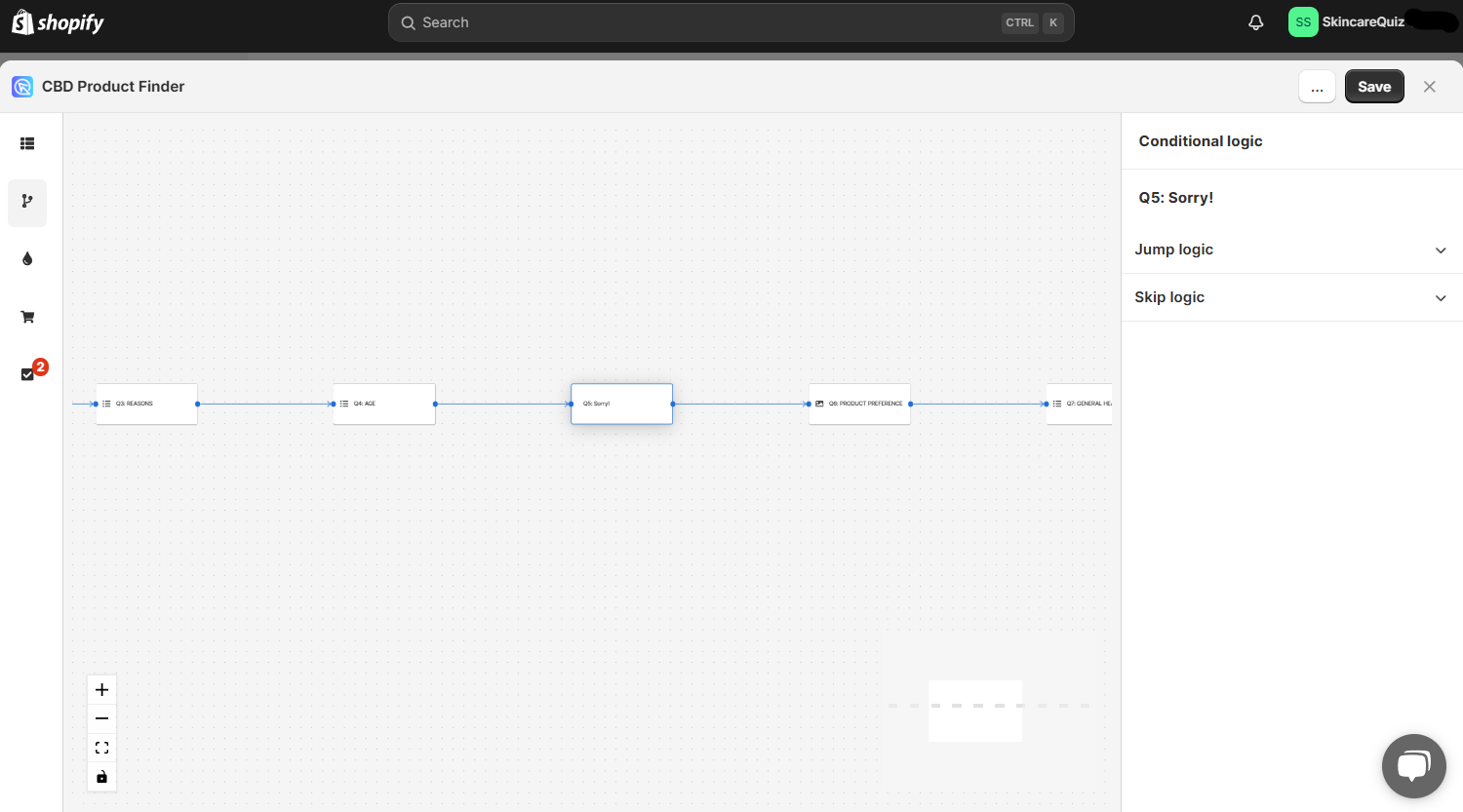
The Conditional logic tab is where you branch a quiz. Rules go in the menu on the right, and the tree on the left redraws itself as you add them.
Without a rule, the quiz runs through the questions in order. Every rule you write is an exception to that order.
Moving around the logic tree

| Control | What it does |
|---|---|
+ |
Zooms in |
- |
Zooms out |
[] |
Centers the tree and fits it to the view |
lock |
Locks the preview, so a stray drag cannot move it |
Drag the tree with the left mouse button to reach a particular branch.
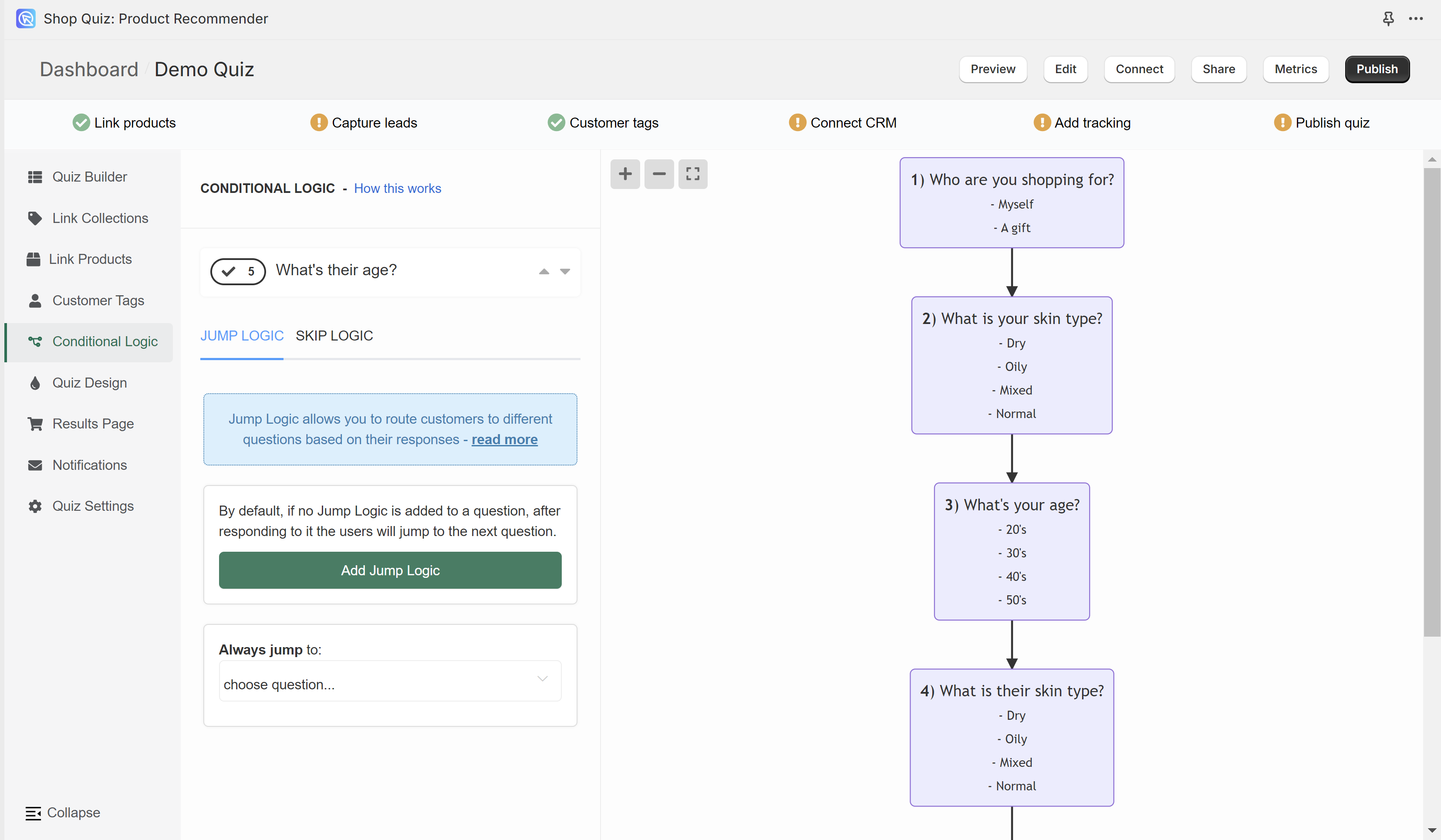
The Conditional Logic tab is where you branch a quiz. Rules go in the menu on the left, and the tree on the right redraws itself as you add them.
Without a rule, the quiz runs through the questions in order. Every rule you write is an exception to that order.
Moving around the logic tree

| Control | What it does |
|---|---|
+ |
Zooms in |
- |
Zooms out |
[] |
Centers the tree and fits it to the view |
Drag the tree with the left mouse button to reach a particular branch.

The arrows in the top menu move you to the question above or the question below.
The Conditional Logic tab is where you branch a quiz. Rules go in the menu on the left, and the tree on the right redraws itself as you add them.
Without a rule, the quiz runs through the questions in order. Every rule you write is an exception to that order.
Moving around the logic tree
| Control | What it does |
|---|---|
+ |
Zooms in |
- |
Zooms out |
[] |
Centers the tree and fits it to the view |
Drag the tree with the left mouse button to reach a particular branch.
The arrows in the top menu move you to the question above or the question below.
The Conditional Logic tab is where you branch a quiz. Rules go in the menu on the left, and the tree on the right redraws itself as you add them.
Without a rule, the quiz runs through the questions in order. Every rule you write is an exception to that order.
Moving around the logic tree
| Control | What it does |
|---|---|
+ |
Zooms in |
- |
Zooms out |
[] |
Centers the tree and fits it to the view |
Drag the tree with the left mouse button to reach a particular branch.
The arrows in the top menu move you to the question above or the question below.
The Conditional Logic tab is where you branch a quiz. Rules go in the menu on the left, and the tree on the right redraws itself as you add them.
Without a rule, the quiz runs through the questions in order. Every rule you write is an exception to that order.
Moving around the logic tree
| Control | What it does |
|---|---|
+ |
Zooms in |
- |
Zooms out |
[] |
Centers the tree and fits it to the view |
Drag the tree with the left mouse button to reach a particular branch.
The arrows in the top menu move you to the question above or the question below.
The Conditional Logic tab is where you branch a quiz. Rules go in the menu on the left, and the tree on the right redraws itself as you add them.
Without a rule, the quiz runs through the questions in order. Every rule you write is an exception to that order.
Moving around the logic tree
| Control | What it does |
|---|---|
+ |
Zooms in |
- |
Zooms out |
[] |
Centers the tree and fits it to the view |
Drag the tree with the left mouse button to reach a particular branch.
The arrows in the top menu move you to the question above or the question below.
Add a skip logic rule
Every rule reads the same way: IF the response to an earlier question is, or is not, a certain choice, THEN this question is skipped. A question carrying no rule is always asked.
-
Open the Quiz builder and go to the Conditional logic tab.
-
Select the question you want to skip. Pick it from the dropdown at the top of the right-hand menu, or click it on the logic tree.
-
Open the
Skip logicdropdown in the menu on the right.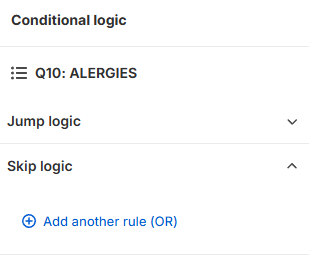
-
Click
+ Add another rule (OR). -
Pick the earlier question the rule reads, then pick
isoris notand the choice.One rule
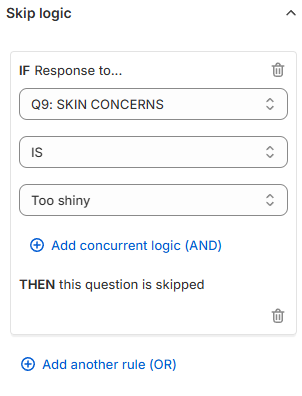
A customer who answers
Too shinyto Question 9, SKIN CONCERNS, is never asked Question 10,ALERGIES. -
Click the top-right
Savebutton, then preview the quiz and answer it as a customer would.
The buttons in the Skip logic panel
| Button | What it does |
|---|---|
+ Add another rule (OR) |
Adds another rule to the question. Any one of them can skip it |
+ Add concurrent logic (AND) |
Adds a second test to the current rule. Both tests must be true |
... |
Opens the rule menu, where you delete the rule |
Most quizzes need only OR rules. An AND rule is easy to write and hard to satisfy, because every test in it has to be true at the same time.
-
Open the Quiz Builder and open the Conditional Logic settings of the question you want to skip.
-
Open the
Skip Logictab. -
Click
Add Skip Logic. -
Pick the earlier question the rule reads, then pick
isoris notand the choice.One rule
A customer who answers
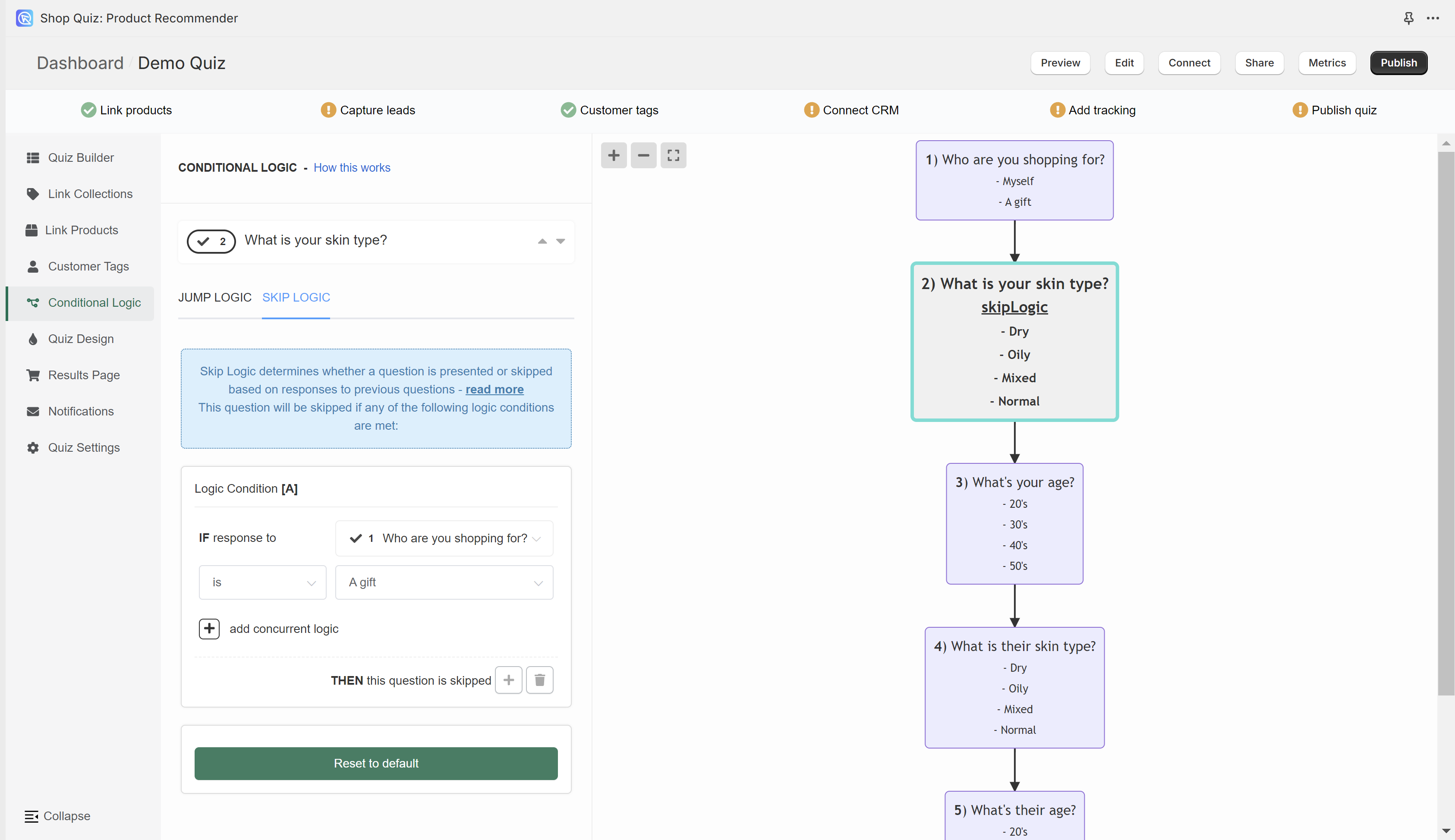
A giftto Question 1, Who are you shopping for?, is never asked Question 2, What is your skin type?. -
Click the top-right
Publishbutton, then preview the quiz and answer it as a customer would.
Every slide carrying a rule is marked skip logic in the builder, so you can see which questions are conditional.
The buttons in the Skip Logic panel
| Button | What it does |
|---|---|
+ |
Adds another rule to the question. Any one of them can skip it |
+ add concurrent logic |
Adds a second test to the current rule. Both tests must be true |
bin |
Deletes the current rule |
Most quizzes need only OR rules. An AND rule is easy to write and hard to satisfy, because every test in it has to be true at the same time.
-
Open the Quiz Builder and open the Conditional Logic settings of the question you want to skip.
-
Open the
Skip Logictab. -
Click
Add Skip Logic. -
Pick the earlier question the rule reads, then pick
isoris notand the choice.One rule
A customer who answers
A giftto Question 1, Who are you shopping for?, is never asked Question 2, What is your skin type?. -
Click the top-right
Publishbutton, then preview the quiz and answer it as a customer would.
Every slide carrying a rule is marked skip logic in the builder, so you can see which questions are conditional.
The buttons in the Skip Logic panel
| Button | What it does |
|---|---|
+ |
Adds another rule to the question. Any one of them can skip it |
+ add concurrent logic |
Adds a second test to the current rule. Both tests must be true |
bin |
Deletes the current rule |
Most quizzes need only OR rules. An AND rule is easy to write and hard to satisfy, because every test in it has to be true at the same time.
-
Open the Quiz Builder and open the Conditional Logic settings of the question you want to skip.
-
Open the
Skip Logictab. -
Click
Add Skip Logic. -
Pick the earlier question the rule reads, then pick
isoris notand the choice.One rule
A customer who answers
A giftto Question 1, Who are you shopping for?, is never asked Question 2, What is your skin type?. -
Click the top-right
Publishbutton, then preview the quiz and answer it as a customer would.
Every slide carrying a rule is marked skip logic in the builder, so you can see which questions are conditional.
The buttons in the Skip Logic panel
| Button | What it does |
|---|---|
+ |
Adds another rule to the question. Any one of them can skip it |
+ add concurrent logic |
Adds a second test to the current rule. Both tests must be true |
bin |
Deletes the current rule |
Most quizzes need only OR rules. An AND rule is easy to write and hard to satisfy, because every test in it has to be true at the same time.
-
Open the Quiz Builder and open the Conditional Logic settings of the question you want to skip.
-
Open the
Skip Logictab. -
Click
Add Skip Logic. -
Pick the earlier question the rule reads, then pick
isoris notand the choice.One rule
A customer who answers
A giftto Question 1, Who are you shopping for?, is never asked Question 2, What is your skin type?. -
Click the top-right
Publishbutton, then preview the quiz and answer it as a customer would.
Every slide carrying a rule is marked skip logic in the builder, so you can see which questions are conditional.
The buttons in the Skip Logic panel
| Button | What it does |
|---|---|
+ |
Adds another rule to the question. Any one of them can skip it |
+ add concurrent logic |
Adds a second test to the current rule. Both tests must be true |
bin |
Deletes the current rule |
Most quizzes need only OR rules. An AND rule is easy to write and hard to satisfy, because every test in it has to be true at the same time.
-
Open the Quiz Builder and open the Conditional Logic settings of the question you want to skip.
-
Open the
Skip Logictab. -
Click
Add Skip Logic. -
Pick the earlier question the rule reads, then pick
isoris notand the choice.One rule
A customer who answers
A giftto Question 1, Who are you shopping for?, is never asked Question 2, What is your skin type?. -
Click the top-right
Publishbutton, then preview the quiz and answer it as a customer would.
Every slide carrying a rule is marked skip logic in the builder, so you can see which questions are conditional.
The buttons in the Skip Logic panel
| Button | What it does |
|---|---|
+ |
Adds another rule to the question. Any one of them can skip it |
+ add concurrent logic |
Adds a second test to the current rule. Both tests must be true |
bin |
Deletes the current rule |
Most quizzes need only OR rules. An AND rule is easy to write and hard to satisfy, because every test in it has to be true at the same time.
Examples
Show only the statement that matches the answer
A skincare quiz asks for the skin type in question 4, and carries one statement slide per type. Skip logic hides the three that do not apply.

-
Open the Quiz builder and add a
Multiple-choice questionasking for the skin type. Offer dry, normal, oily and combination.Help the customer answer
Describe each skin type in an image or text block, so the customer can tell which one fits.
-
Add one
Statementslide per skin type.Four statements, one per skin type
- You have Dry Skin: The itchiness, the tightness, the dryness. Your skin wants a routine that is deeply nourishing and hydrating.
- You have Normal Skin: Your skin feels balanced, just like you. It has no major issues, and it still deserves care that sustains that natural harmony.
- You have Oily Skin: Your skin is shiny with excess oil rather than a natural glow. It wants a routine that balances and clarifies, with light hydration.
- You have Combination-Type Skin: Your T-zone runs oily, while the rest of your face is normal or dry.
-
Go to the Conditional logic tab and select the dry skin statement.
-
Find
Skip logicin the menu on the right, and click+ Add another rule (OR). -
Set the rule to
IF the response tothe skin type questionis notthe dry skin choice.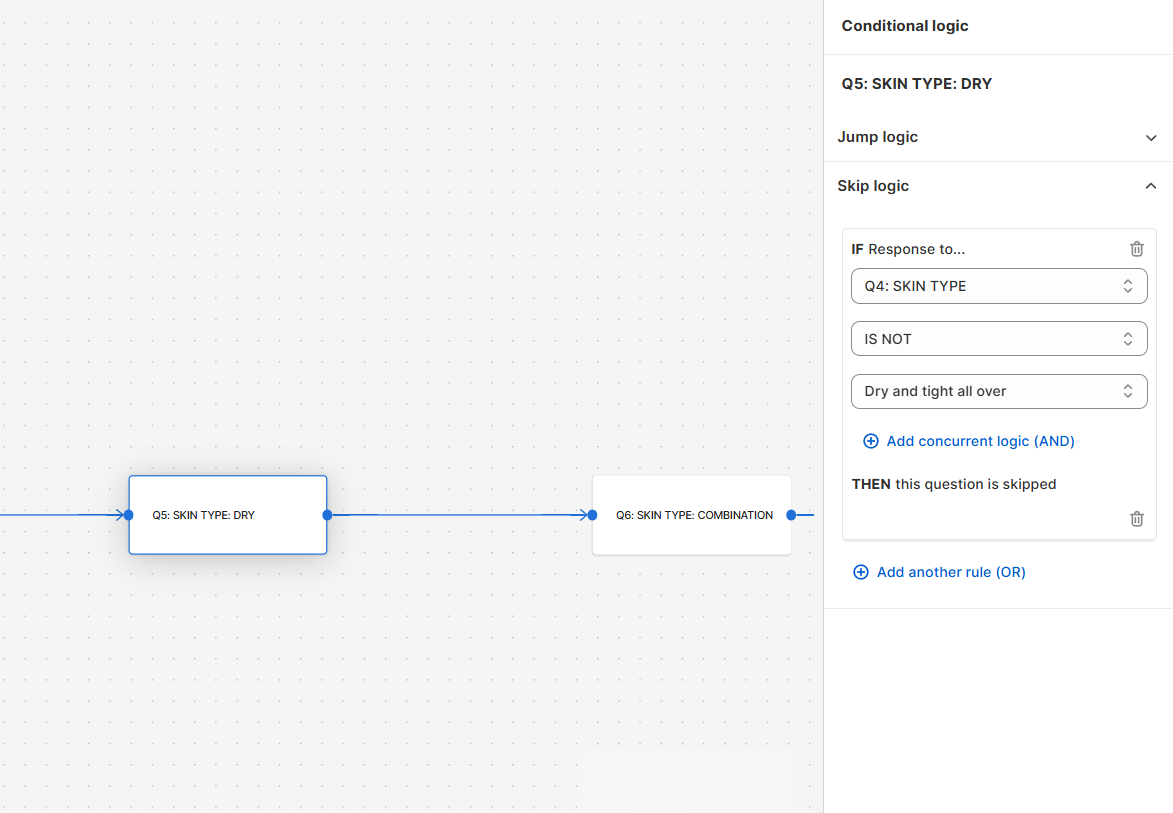
The statement is then skipped for every answer except that one.
-
Repeat for the other three statements, each reading its own choice.
-
Click the top-right
Savebutton, then answer the quiz once per skin type. Only the matching statement should appear each time.
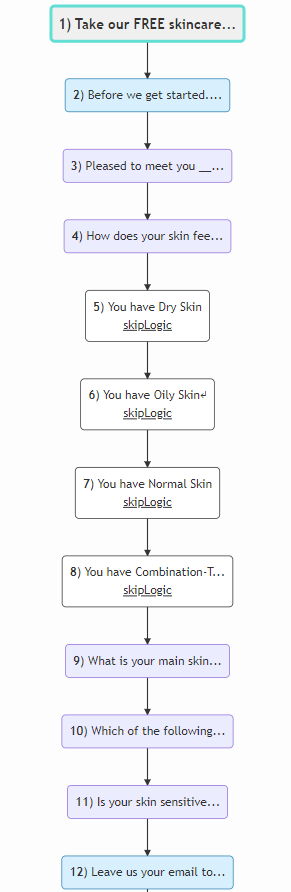
A skincare quiz asks for the skin type, and carries one statement slide per type. Skip Logic hides the three that do not apply.
-
Open the Quiz Builder and add a
Multiple-choice questionasking for the skin type. Offer dry, normal, oily and combination.Help the customer answer
Describe each skin type in
Question Settings -> Show Description, so the customer can tell which one fits. -
Add one
Statementslide per skin type.Four statements, one per skin type
- You have Dry Skin: The itchiness, the tightness, the dryness. Your skin wants a routine that is deeply nourishing and hydrating.
- You have Normal Skin: Your skin feels balanced, just like you. It has no major issues, and it still deserves care that sustains that natural harmony.
- You have Oily Skin: Your skin is shiny with excess oil rather than a natural glow. It wants a routine that balances and clarifies, with light hydration.
- You have Combination-Type Skin: Your T-zone runs oily, while the rest of your face is normal or dry.
-
Open the Conditional Logic settings of the dry skin statement.
-
Open the
Skip Logictab and clickAdd Skip Logic. -
Set the rule to
IF response tothe skin type questionis notthe dry skin choice.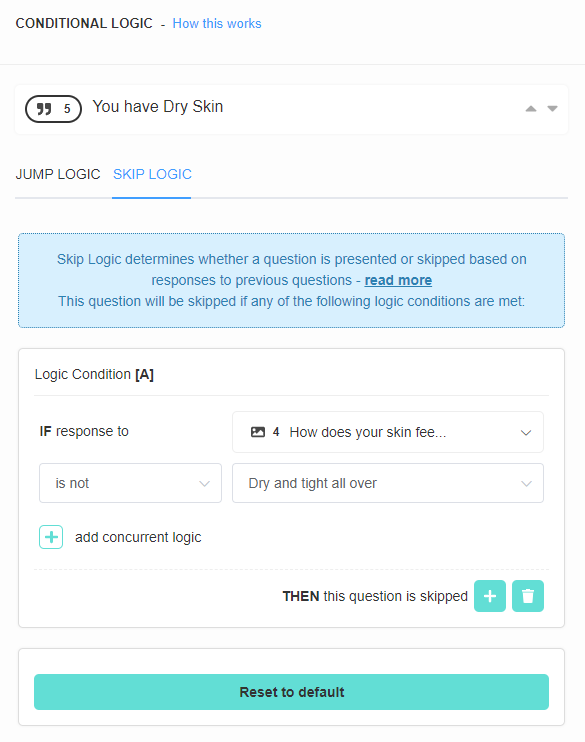
The statement is then skipped for every answer except that one.
-
Repeat for the other three statements, each reading its own choice.
-
Click the top-right
Publishbutton, then answer the quiz once per skin type. Only the matching statement should appear each time.
A skincare quiz asks for the skin type, and carries one statement slide per type. Skip Logic hides the three that do not apply.
-
Open the Quiz Builder and add a
Multiple-choice questionasking for the skin type. Offer dry, normal, oily and combination.Help the customer answer
Describe each skin type in
Question Settings -> Show Description, so the customer can tell which one fits. -
Add one
Statementslide per skin type.Four statements, one per skin type
- You have Dry Skin: The itchiness, the tightness, the dryness. Your skin wants a routine that is deeply nourishing and hydrating.
- You have Normal Skin: Your skin feels balanced, just like you. It has no major issues, and it still deserves care that sustains that natural harmony.
- You have Oily Skin: Your skin is shiny with excess oil rather than a natural glow. It wants a routine that balances and clarifies, with light hydration.
- You have Combination-Type Skin: Your T-zone runs oily, while the rest of your face is normal or dry.
-
Open the Conditional Logic settings of the dry skin statement.
-
Open the
Skip Logictab and clickAdd Skip Logic. -
Set the rule to
IF response tothe skin type questionis notthe dry skin choice.The statement is then skipped for every answer except that one.
-
Repeat for the other three statements, each reading its own choice.
-
Click the top-right
Publishbutton, then answer the quiz once per skin type. Only the matching statement should appear each time.
A skincare quiz asks for the skin type, and carries one statement slide per type. Skip Logic hides the three that do not apply.
-
Open the Quiz Builder and add a
Multiple-choice questionasking for the skin type. Offer dry, normal, oily and combination.Help the customer answer
Describe each skin type in
Question Settings -> Show Description, so the customer can tell which one fits. -
Add one
Statementslide per skin type.Four statements, one per skin type
- You have Dry Skin: The itchiness, the tightness, the dryness. Your skin wants a routine that is deeply nourishing and hydrating.
- You have Normal Skin: Your skin feels balanced, just like you. It has no major issues, and it still deserves care that sustains that natural harmony.
- You have Oily Skin: Your skin is shiny with excess oil rather than a natural glow. It wants a routine that balances and clarifies, with light hydration.
- You have Combination-Type Skin: Your T-zone runs oily, while the rest of your face is normal or dry.
-
Open the Conditional Logic settings of the dry skin statement.
-
Open the
Skip Logictab and clickAdd Skip Logic. -
Set the rule to
IF response tothe skin type questionis notthe dry skin choice.The statement is then skipped for every answer except that one.
-
Repeat for the other three statements, each reading its own choice.
-
Click the top-right
Publishbutton, then answer the quiz once per skin type. Only the matching statement should appear each time.
A skincare quiz asks for the skin type, and carries one statement slide per type. Skip Logic hides the three that do not apply.
-
Open the Quiz Builder and add a
Multiple-choice questionasking for the skin type. Offer dry, normal, oily and combination.Help the customer answer
Describe each skin type in
Question Settings -> Show Description, so the customer can tell which one fits. -
Add one
Statementslide per skin type.Four statements, one per skin type
- You have Dry Skin: The itchiness, the tightness, the dryness. Your skin wants a routine that is deeply nourishing and hydrating.
- You have Normal Skin: Your skin feels balanced, just like you. It has no major issues, and it still deserves care that sustains that natural harmony.
- You have Oily Skin: Your skin is shiny with excess oil rather than a natural glow. It wants a routine that balances and clarifies, with light hydration.
- You have Combination-Type Skin: Your T-zone runs oily, while the rest of your face is normal or dry.
-
Open the Conditional Logic settings of the dry skin statement.
-
Open the
Skip Logictab and clickAdd Skip Logic. -
Set the rule to
IF response tothe skin type questionis notthe dry skin choice.The statement is then skipped for every answer except that one.
-
Repeat for the other three statements, each reading its own choice.
-
Click the top-right
Publishbutton, then answer the quiz once per skin type. Only the matching statement should appear each time.
A skincare quiz asks for the skin type, and carries one statement slide per type. Skip Logic hides the three that do not apply.
-
Open the Quiz Builder and add a
Multiple-choice questionasking for the skin type. Offer dry, normal, oily and combination.Help the customer answer
Describe each skin type in
Question Settings -> Show Description, so the customer can tell which one fits. -
Add one
Statementslide per skin type.Four statements, one per skin type
- You have Dry Skin: The itchiness, the tightness, the dryness. Your skin wants a routine that is deeply nourishing and hydrating.
- You have Normal Skin: Your skin feels balanced, just like you. It has no major issues, and it still deserves care that sustains that natural harmony.
- You have Oily Skin: Your skin is shiny with excess oil rather than a natural glow. It wants a routine that balances and clarifies, with light hydration.
- You have Combination-Type Skin: Your T-zone runs oily, while the rest of your face is normal or dry.
-
Open the Conditional Logic settings of the dry skin statement.
-
Open the
Skip Logictab and clickAdd Skip Logic. -
Set the rule to
IF response tothe skin type questionis notthe dry skin choice.The statement is then skipped for every answer except that one.
-
Repeat for the other three statements, each reading its own choice.
-
Click the top-right
Publishbutton, then answer the quiz once per skin type. Only the matching statement should appear each time.
Ask only the follow-up questions the customer needs
A beauty quiz lets the customer pick several skin concerns at once, then asks a follow-up question about each concern they picked.
-
Add a multiple-choice question and allow several selections. The setting sits in the Multiple Choice block settings.
-
Add one follow-up question per choice, in the same order as the choices.
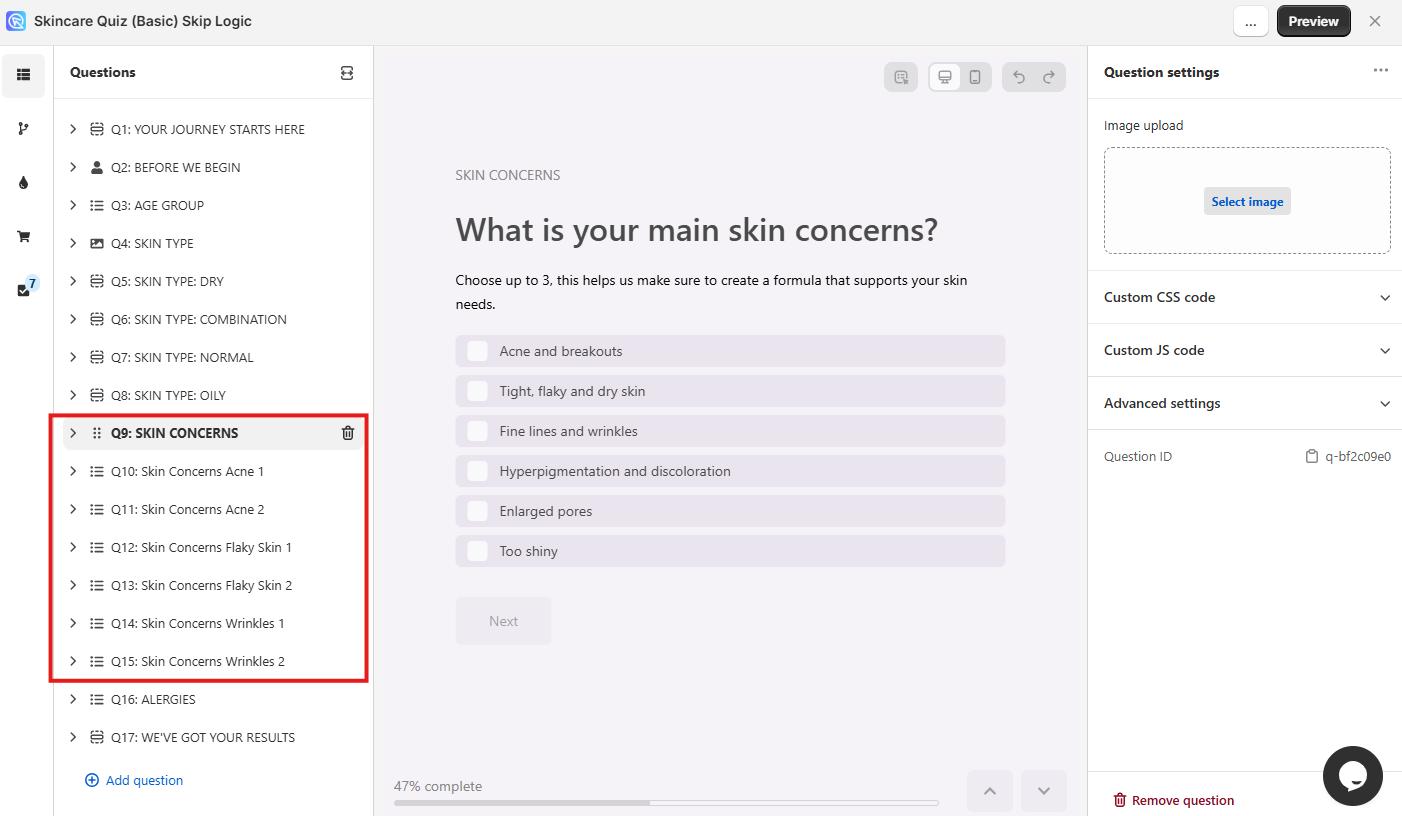
Keep the two lists in the same order
A follow-up question has to sit in the same position as its choice. If
Acneis the first choice, its follow-up has to be the first follow-up question. -
Go to the Conditional logic tab and select the first follow-up question.
-
Set the rule to
IF the response tothe concerns questionis notthat question's own concern.The acne follow-up
IF the response to the question Q9: Skin Concerns is not acne, then this question is skipped.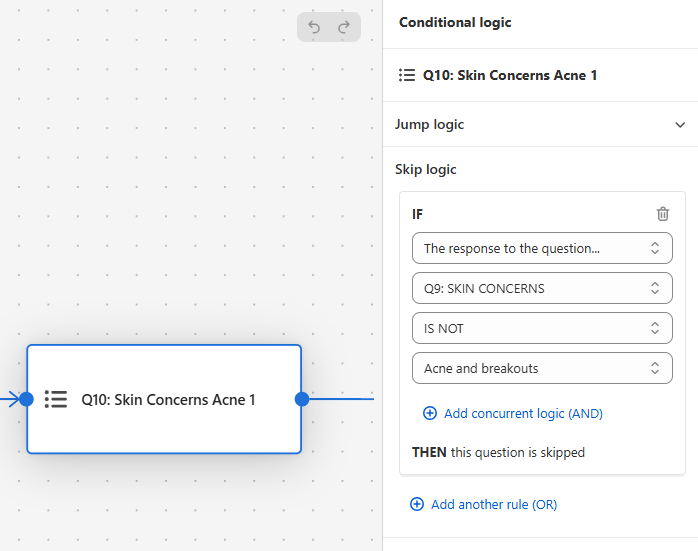
-
Repeat for every other follow-up question.
-
Click the top-right
Savebutton, then answer the quiz picking two concerns. Only the follow-up questions for those two should appear.
Why the rule reads is not
A rule phrased as is not skips the question for everyone who did not pick that choice, and shows it to everyone who did. The quiz keeps one straight path, however many choices the customer makes.
A beauty quiz lets the customer pick several areas to focus on at once, then asks the follow-up questions for each area they picked.
-
Add a question asking which areas the customer wants to focus on. For example nails, skin, hair and makeup.
Allow several selections
The setting sits in block settings, multiple-choice settings.
-
Add the follow-up questions for each area, grouped together and in the order of the choices.
Questions Area 2 and 3 Nails 4 and 5 Skin 6 and 7 Hair 8 and 9 Makeup -
Add a skip logic rule to every follow-up question, reading its own area.
The nail questions
IF response to Question 1 is not Nails, then this question is skipped.Questions 4 and 5 read
Skin, questions 6 and 7 readHair, and questions 8 and 9 readMakeup. -
Click the top-right
Publishbutton, then answer the quiz picking two areas. Only the questions for those two areas should appear.
Why the rule reads is not
A rule phrased as is not skips the question for everyone who did not pick that choice, and shows it to everyone who did. The quiz keeps one straight path, however many choices the customer makes.
A beauty quiz lets the customer pick several areas to focus on at once, then asks the follow-up questions for each area they picked.
-
Add a question asking which areas the customer wants to focus on. For example nails, skin, hair and makeup.
Allow several selections
The setting sits in block settings, multiple-choice settings.
-
Add the follow-up questions for each area, grouped together and in the order of the choices.
Questions Area 2 and 3 Nails 4 and 5 Skin 6 and 7 Hair 8 and 9 Makeup -
Add a skip logic rule to every follow-up question, reading its own area.
The nail questions
IF response to Question 1 is not Nails, then this question is skipped.Questions 4 and 5 read
Skin, questions 6 and 7 readHair, and questions 8 and 9 readMakeup. -
Click the top-right
Publishbutton, then answer the quiz picking two areas. Only the questions for those two areas should appear.
Why the rule reads is not
A rule phrased as is not skips the question for everyone who did not pick that choice, and shows it to everyone who did. The quiz keeps one straight path, however many choices the customer makes.
A beauty quiz lets the customer pick several areas to focus on at once, then asks the follow-up questions for each area they picked.
-
Add a question asking which areas the customer wants to focus on. For example nails, skin, hair and makeup.
Allow several selections
The setting sits in block settings, multiple-choice settings.
-
Add the follow-up questions for each area, grouped together and in the order of the choices.
Questions Area 2 and 3 Nails 4 and 5 Skin 6 and 7 Hair 8 and 9 Makeup -
Add a skip logic rule to every follow-up question, reading its own area.
The nail questions
IF response to Question 1 is not Nails, then this question is skipped.Questions 4 and 5 read
Skin, questions 6 and 7 readHair, and questions 8 and 9 readMakeup. -
Click the top-right
Publishbutton, then answer the quiz picking two areas. Only the questions for those two areas should appear.
Why the rule reads is not
A rule phrased as is not skips the question for everyone who did not pick that choice, and shows it to everyone who did. The quiz keeps one straight path, however many choices the customer makes.
A beauty quiz lets the customer pick several areas to focus on at once, then asks the follow-up questions for each area they picked.
-
Add a question asking which areas the customer wants to focus on. For example nails, skin, hair and makeup.
Allow several selections
The setting sits in block settings, multiple-choice settings.
-
Add the follow-up questions for each area, grouped together and in the order of the choices.
Questions Area 2 and 3 Nails 4 and 5 Skin 6 and 7 Hair 8 and 9 Makeup -
Add a skip logic rule to every follow-up question, reading its own area.
The nail questions
IF response to Question 1 is not Nails, then this question is skipped.Questions 4 and 5 read
Skin, questions 6 and 7 readHair, and questions 8 and 9 readMakeup. -
Click the top-right
Publishbutton, then answer the quiz picking two areas. Only the questions for those two areas should appear.
Why the rule reads is not
A rule phrased as is not skips the question for everyone who did not pick that choice, and shows it to everyone who did. The quiz keeps one straight path, however many choices the customer makes.
A beauty quiz lets the customer pick several areas to focus on at once, then asks the follow-up questions for each area they picked.
-
Add a question asking which areas the customer wants to focus on. For example nails, skin, hair and makeup.
Allow several selections
The setting sits in block settings, multiple-choice settings.
-
Add the follow-up questions for each area, grouped together and in the order of the choices.
Questions Area 2 and 3 Nails 4 and 5 Skin 6 and 7 Hair 8 and 9 Makeup -
Add a skip logic rule to every follow-up question, reading its own area.
The nail questions
IF response to Question 1 is not Nails, then this question is skipped.Questions 4 and 5 read
Skin, questions 6 and 7 readHair, and questions 8 and 9 readMakeup. -
Click the top-right
Publishbutton, then answer the quiz picking two areas. Only the questions for those two areas should appear.
Why the rule reads is not
A rule phrased as is not skips the question for everyone who did not pick that choice, and shows it to everyone who did. The quiz keeps one straight path, however many choices the customer makes.
A quiz built entirely on skipped slides
Ask for an email only when the customer offers one
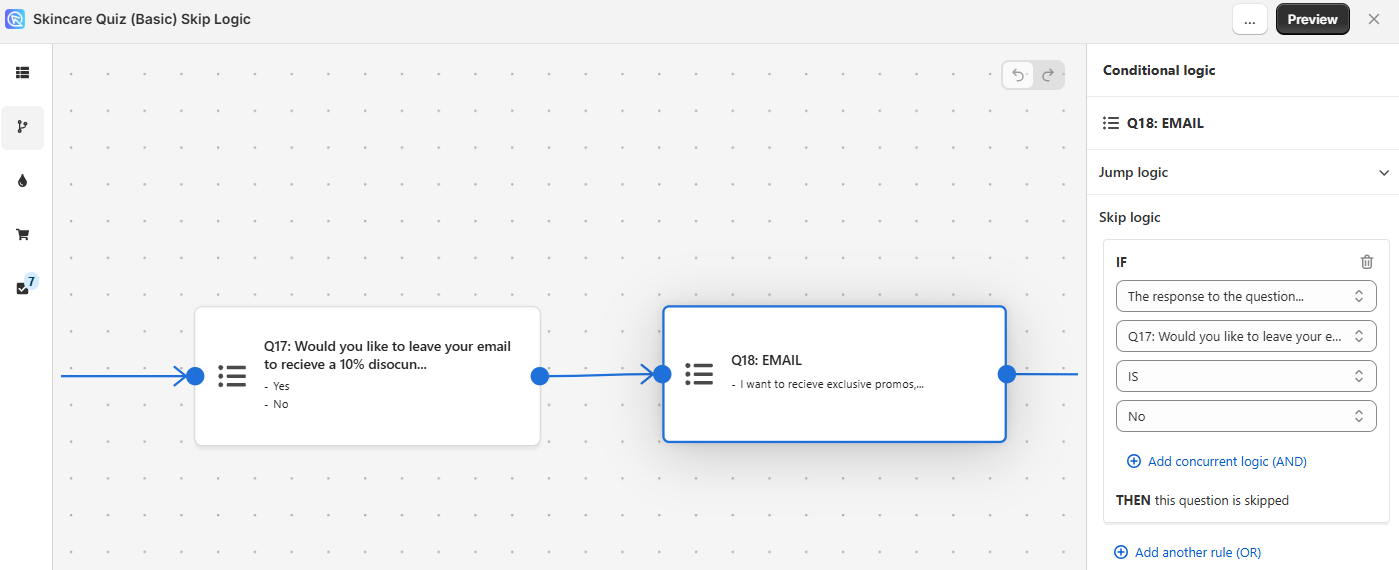
-
Add a
Yes/No questionasking whether the customer will leave an email address. -
Add an
Email addressquestion after it. -
Add a skip logic rule to the email question, reading
IF the response tothe yes or no questionisNo.
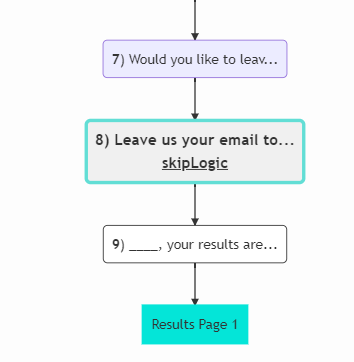
A customer who declines goes straight on to the results page, and is never asked for an address.
-
Add a
Yes/No questionasking whether the customer will leave an email address. -
Add an
emailinput question after it. -
Add a Skip Logic rule to the email question, reading
IF response tothe yes or no questionisNo.
A customer who declines goes straight on to the Results Page, and is never asked for an address.
-
Add a
Yes/No questionasking whether the customer will leave an email address. -
Add an
emailinput question after it. -
Add a Skip Logic rule to the email question, reading
IF response tothe yes or no questionisNo.
A customer who declines goes straight on to the Results Page, and is never asked for an address.
-
Add a
Yes/No questionasking whether the customer will leave an email address. -
Add an
emailinput question after it. -
Add a Skip Logic rule to the email question, reading
IF response tothe yes or no questionisNo.
A customer who declines goes straight on to the Results Page, and is never asked for an address.
-
Add a
Yes/No questionasking whether the customer will leave an email address. -
Add an
emailinput question after it. -
Add a Skip Logic rule to the email question, reading
IF response tothe yes or no questionisNo.
A customer who declines goes straight on to the Results Page, and is never asked for an address.
-
Add a
Yes/No questionasking whether the customer will leave an email address. -
Add an
emailinput question after it. -
Add a Skip Logic rule to the email question, reading
IF response tothe yes or no questionisNo.
A customer who declines goes straight on to the Results Page, and is never asked for an address.
Skip logic and jump logic
Both rules change which question comes next, and they go about it differently.
| Rule | What it does |
|---|---|
| Skip logic | Leaves the path alone, and drops the questions that do not apply |
| Jump logic | Sends the customer to a named destination, so the quiz splits into separate paths |
Use skip logic when there is one path, and some questions on it are irrelevant to some customers. Use jump logic when the paths diverge and stay apart.
Do not use both in one quiz.
Additional resources
Read up on boolean logic before writing complex AND/OR rules. WolframAlpha evaluates a rule you type in, and Khan Academy explains how AND and OR combine.
See how to use conditional logic for the other kinds of logic a quiz can use.
This article explains how to write skip logic rules, and how to hide the questions a customer does not need.